
For most patients, flying after an embryo transfer is considered safe, and many clinics allow travel the next day. A 2025 study of 2,135 transfers found no meaningful difference in pregnancy, implantation or miscarriage rates between patients who flew home and those who did not. Flying after egg retrieval is a different question, because your body is recovering from a procedure and a stimulated cycle. The right timing depends on your cycle, and your care team should confirm it before you book.
This guide covers both procedures, what the evidence says, and how to lower the real risks of flying, mainly blood clots and, after retrieval, ovarian overstimulation. It also covers the practical side for patients who travel to us for treatment.
TL;DR
- Air travel after embryo transfer has not been linked to worse IVF outcomes in the available retrospective research. Many patients fly the day after the transfer.
- The embryo is not dislodged by turbulence, cabin pressure or walking through an airport. Bed rest does not improve pregnancy rates either.
- The medical concern with flying is venous thromboembolism (blood clots), not the embryo. Hydrate, move regularly and ask your team about compression stockings.
- After egg retrieval, wait for your team’s clearance. Bloating, pain, breathlessness or reduced urination need medical attention before you fly.
- Always confirm your plan with your own clinic. A history of clots or a high response to stimulation changes the advice.
Table of Contents
- Does flying affect implantation?
- Why the embryo stays put
- When can you fly after an embryo transfer?
- Flying after egg retrieval
- The real risk: blood clots
- Your travel plan, step by step
- Driving, trains and other options
- Our perspective on traveling for treatment
- Planning treatment with Life IVF Center
- FAQ
- Sources
Does flying affect implantation?
Many patients worry that flying will undo the transfer. Researchers wanted to know whether that worry has any basis, particularly because so many people now travel for fertility care.
The most relevant evidence is a retrospective study published in 2025, “Does flying after embryo transfer impact implantation?”. It compared patients who flew after transfer with those who did not, across 2,135 transfers. The results were close to identical:
| Outcome | Did not fly | Flew after transfer |
|---|---|---|
| Pregnancy rate | 61.99% | 62.14% |
| Implantation rate | 34.58% | 38.65% |
The difference in pregnancy rate was not statistically significant (p=0.94), and neither was the difference in implantation rate (p=0.28). Miscarriage rates did not differ significantly either. These figures come from that study’s patient population, not from Life IVF Center, and they should not be read as a prediction for any individual cycle.
Two caveats matter. The study is retrospective, so patients were not randomly assigned to fly or stay, and the authors themselves note that prospective research is still recommended. Still, the data point the same direction: returning home by air after transfer does not appear to compromise treatment success. The authors also suggest that letting patients go home soon after transfer may reduce stress, which counts for something during a stressful treatment.
Why the embryo stays put
The idea that an embryo can be shaken loose is one of the most persistent myths in fertility care. It does not match the anatomy or the clinical evidence.
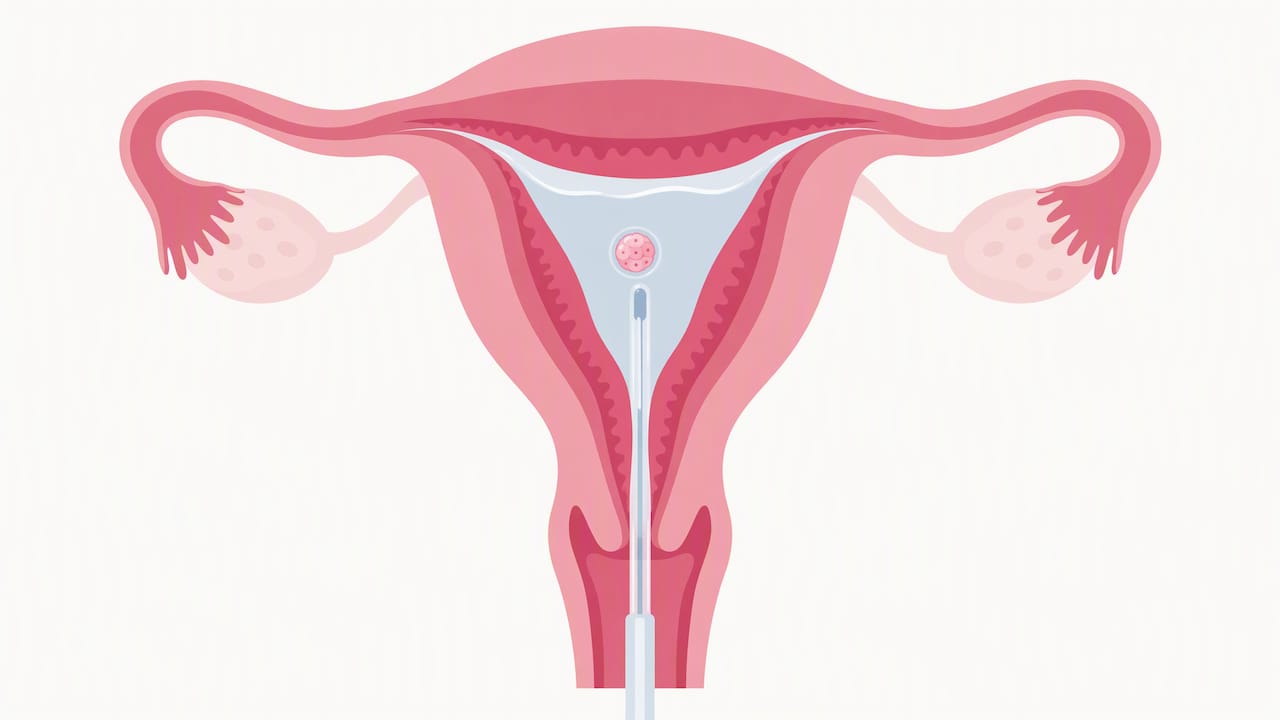
During a transfer, the embryo is placed in the central area of the uterine cavity using a soft catheter. The ASRM’s guideline on performing the embryo transfer lists the techniques supported by evidence, and immediate ambulation, meaning getting up and walking rather than lying flat, is part of standard practice. The uterus is a muscular organ, and the embryo sits within a thin layer of fluid against the lining. Walking, sitting upright, climbing stairs and changes in cabin pressure do not move it.
Bed rest has the same lack of support. The earlier habit of lying down for hours or days came from understandable worry, not from clinical benefit. Studies have shown that bed rest of any length does not raise pregnancy or live-birth rates, and some reports suggest it could even be counterproductive. For most patients, low-impact normal activity is encouraged.
That applies to a flight. Sitting in a seat is not riskier for the embryo than sitting on a sofa.
When can you fly after an embryo transfer?
There is no single universal rule, so your clinic’s instruction comes first. In general:
- Same day: Some patients fly the evening of the transfer. Many clinicians prefer a night of rest first, mainly for comfort.
- The next day: This is the most common recommendation for patients who live elsewhere. Clinics that treat many out-of-area patients are used to it.
- During the two-week wait: Flying is generally acceptable if you feel well. ACOG’s committee opinion on air travel during pregnancy states that, without obstetric or medical complications, occasional air travel is safe for pregnant women, who can follow the same precautions as the general population.
That last point carries over to the early weeks of pregnancy. ACOG’s guidance concerns pregnancy in general, and it does not address the first days after a transfer specifically, so treat it as supportive context rather than a transfer-specific rule.
Frozen embryo transfer (FET)
The same reasoning applies. A frozen transfer involves no egg retrieval and usually no stimulation cycle, so you are typically more comfortable and more mobile afterward. Questions about flying after FET usually come down to medication timing, your pregnancy test date and where you will be when the result arrives. If your results will be drawn at a lab near home, ask your clinic how the blood test will be ordered and who will read the result.
Flying after egg retrieval
Retrieval is a different situation. It is a minor procedure done under sedation, and your ovaries are enlarged from stimulation. Here, the question is how you feel and how your body responded, not the embryo.
Most patients feel bloated and crampy for a few days. Whether you can fly the next day depends on your response to the medication, how many follicles were retrieved, how you recovered from sedation, and whether anything suggests ovarian hyperstimulation syndrome (OHSS). Patients with a high response should expect more caution from their team.
Talk to your clinic before flying, and do not board, if you have:
- Severe or worsening bloating or abdominal pain
- Shortness of breath or chest pain
- Dizziness or fainting
- Heavy bleeding or fever
- Persistent vomiting or noticeably reduced urination
These signs can mean OHSS or another complication that needs evaluation, and being in the air or in an unfamiliar city makes that harder to handle. Chest pain or breathlessness can be signs of a clot in the lungs, and they call for emergency care, not a flight.
If you plan a fresh cycle with a transfer a few days after retrieval, or a freeze-all cycle with a later transfer, ask for the sequence in writing so you can book flexible tickets.
The real risk: blood clots
The medical concern around flying is not implantation. It is venous thromboembolism, a clot that forms in a deep vein and can travel to the lungs. ACOG explains that a clot in a deep vein can break free and move to the lungs, which is very serious.
Two things raise the baseline. Pregnancy itself does: ACOG’s practice bulletin notes a fourfold to fivefold higher risk of thromboembolism in pregnant and postpartum women compared with nonpregnant women. High estrogen levels from stimulation, especially with a strong ovarian response, can add to the risk, and so can long periods of sitting.
For most patients, the precautions are simple:
- Hydrate. Bring an empty bottle through security and fill it at the gate.
- Move. Walk the aisle when the seatbelt sign allows, and flex and rotate your ankles while seated.
- Choose an aisle seat so you can stand without climbing over anyone.
- Wear loose clothing that does not restrict circulation at the waist or legs.
- Ask about compression stockings if you have personal risk factors. They should be recommended by your physician, not chosen on a whim.
Tell your care team in advance if you have had a clot before, have a known clotting disorder, or have a family history of clots. These factors can change the advice, including whether anticoagulant medication is appropriate. That is a decision for your physician.
If you want a gentle, low-effort way to keep moving once you are pregnant, a pregnancy planner site has a guide to clinician-vetted stretches for round ligament pain. Check any new exercise with your OB or fertility team first.
Your travel plan, step by step
A smooth trip is mostly about logistics. Here is a sequence that works for patients who travel for treatment.
- Plan before you book. Ask your clinic for the dates of baseline testing, monitoring, retrieval and transfer, and whether a freeze-all approach is likely. Book refundable or changeable flights.
- Carry medications in your hand luggage. Keep them in their original packaging with prescriptions and, if possible, a letter from your clinic. Never check injectables or hormones in a hold that may be delayed or exposed to extreme temperatures.
- Schedule the flight after the transfer, not before the end of your appointments. Leave a buffer for delays on the day of the procedure.
- Choose a short route where you can. Direct flights reduce time sitting and the chance of a missed connection.
- Plan your pregnancy test. Know the date, the lab, and who will call you with the result. Testing too early can mislead you.
- Know your local emergency options. Identify the hospital nearest your destination and keep your clinic’s after-hours number in your phone.
Where you are going matters
If you are traveling abroad after transfer, check the destination. CDC guidance for counseling travelers asks clinicians to discuss whether the area has Zika risk, and where travel to a risk area cannot be avoided, to follow guidance on preventing mosquito bites and sexual transmission. Also confirm that the area has a hospital that can manage early pregnancy complications. A remote resort with no nearby emergency care is a poor choice during the two-week wait.
Driving, trains and other options
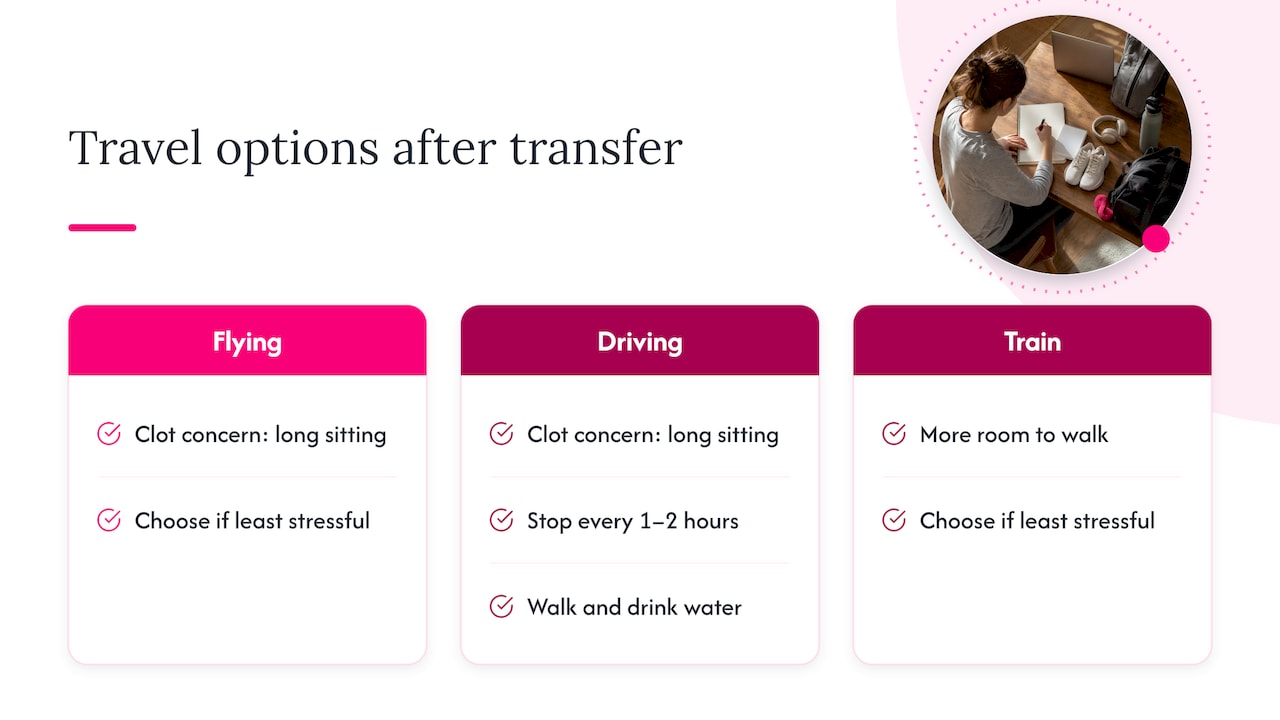
If you would rather not fly, other modes are fine. A long car ride is not harmful for the embryo, but it has the same clot-related drawback as a flight: long periods of sitting. Stop every one to two hours, walk for a few minutes and drink water. Trains offer more room to walk. Choose what is least stressful for you, because for many patients that is the factor that matters most.
Your comfort is a legitimate reason to adjust plans. If a flight home adds anxiety, staying one more night near your clinic is a perfectly reasonable choice. If staying means three extra days of hotel bills and stress, flying the next day is supported by the research.
Our perspective on traveling for treatment
We see many patients who come to us from other states and countries, often after being told elsewhere that their case is too difficult. Travel is a real part of their treatment, not an afterthought, so we plan for it from the first consultation.
Our approach is to treat the flight as part of the cycle plan. Under Precision IVF®, protocols are built around each patient’s biology and history, and that includes the factors that decide when it is safe to fly: how you responded to stimulation, your personal clot risk and your recovery. A patient with a mild response and a straightforward frozen transfer has a different travel window from a patient with a very high response. We would rather tell you that plainly than give everyone the same rule.
We also want you to stop blaming yourself. The evidence does not support the fear that a flight, a walk through an airport or a bumpy landing can harm an embryo. If a cycle does not work, it was not the plane. Our team can coordinate travel logistics and walk you through financial guidance, so that you can focus on the treatment itself.
Planning treatment with Life IVF Center
If you are thinking about traveling for care, it helps to know the costs and steps before you book flights. Life IVF Center publishes its fees. Embryo Transfer starts from $2,950, and the Advanced IVF Package is $13,500. Our freezing pricing lists Precision Egg Freezing at $7,500 and Precision Embryo Freezing at $8,950, which is useful if your plan includes a later frozen transfer closer to home. Pre-treatment testing, such as carrier screening at $349 or the Endometrial Receptivity Assay at $975, is listed on our pre-IVF testing page.
To discuss your case and your travel timeline, start at lifeivfcenter.com.
FAQ
Can I fly during the two-week wait?
Yes, for most patients who feel well. The available research found no negative effect of air travel on pregnancy or implantation rates, and ACOG considers occasional air travel safe in pregnancy without complications. Follow the standard precautions for clots, and tell your clinic if you have risk factors.
Can you fly after egg retrieval?
Often yes, but only after your care team has checked how you are recovering. Bloating and cramping are common, though severe pain, breathlessness, dizziness, heavy bleeding or reduced urination need medical attention first. Patients with a strong response to stimulation may be asked to wait.
Can turbulence or cabin pressure dislodge the embryo?
No. The embryo is placed in the uterine cavity and attaches to the lining, and routine movement and flight conditions do not displace it. Bed rest has not been shown to improve pregnancy or live-birth rates.
How soon after an embryo transfer can I fly home?
Many clinics allow flying the day after the transfer, and some patients fly the same evening. Your clinic’s own instruction takes priority, since it knows your medical history and cycle details.
Should I wear compression stockings on the flight?
Only if your physician recommends them based on your personal risk factors, such as a previous clot. For everyone, hydration and regular movement are the basic precautions.
Sources
- Does flying after embryo transfer impact implantation? (PMC, 2025)
- Air Travel During Pregnancy, ACOG Committee Opinion
- Thromboembolism in Pregnancy, ACOG Practice Bulletin
- Preventing Deep Vein Thrombosis, ACOG
- Performing the Embryo Transfer: A Guideline, ASRM
- Counseling Travelers, CDC
This article is for general educational purposes only and is not a substitute for personalized medical advice, diagnosis, or treatment. Fertility care is highly individual; please consult a qualified healthcare professional about your specific circumstances.
Ready to take the next step?
Life IVF Center specializes in individualized Precision IVF® care for complex cases—including diminished ovarian reserve, prior failed cycles, and advanced maternal age. Our in-house labs and dedicated physicians are ready to help.
Book a Free Consultation →