
Properly vitrified embryos in well-maintained storage can remain viable for many years. Pooled analyses of the research find no measurable decline in pregnancy outcomes across the storage ranges studied, though one large cohort suggests caution beyond roughly five years in small samples. Read the evidence summary and our clinic checklist below to see what matters in practice.
TL;DR:
- A cohort of 9,806 cycles found similar outcomes through 12 months, while its small group stored beyond five years had lower pregnancy and birth rates.
- Later transfers may involve lower grade embryos because patients often use their strongest first; age at retrieval and uterine health also shape outcomes.
- At about minus 196 degrees Celsius, liquid nitrogen storage pauses biological aging; ask whether the clinic monitors levels continuously and keeps backup tanks.
- U.S. clinics set their own renewal and unclaimed embryo policies; Life IVF Center charges $750 yearly, $2,000 prepaid for three years, or $70 monthly.
Table of Contents
- What does the research say about embryo storage time and pregnancy outcomes?
- How do vitrification and cryostorage keep embryos on pause?
- What factors influence embryo outcomes over time?
- What are the practical storage rules, consent requirements, and fees?
- What should you ask your clinic, and how do we protect stored embryos?
- Does storage time affect genetic testing and embryo selection?
- What is it like emotionally to keep embryos in storage for years?
- How we think about transfer timing versus continued storage
- How to start with embryo freezing and secure storage at Life IVF Center
- FAQ
- Sources
What does the research say about embryo storage time and pregnancy outcomes?
The most useful place to start is the pooled evidence, because single studies can mislead in either direction. A dose-response meta-analysis of cryostorage duration looked for any relationship between how long embryos were stored and how they performed afterward. It found no linear or non-linear association between storage time, within the ranges evaluated, and survival rate, implantation rate, miscarriage rate, clinical pregnancy rate, or live birth rate.
Key finding: in the dose-response meta-analysis, storage duration showed no association with survival, implantation, miscarriage, clinical pregnancy, or live birth within the analyzed ranges. In plain terms, the clock on the freezer door was not a reliable predictor of how an embryo would do once transferred.
A second synthesis points the same direction for the modern freezing method. A systematic review and meta-analysis of extended storage after vitrification reported that prolonged cryo-storage beyond 12 months did not show a harmful impact on cryo-survival or clinical outcomes overall. The authors were candid about limits: the evidence base is modest and the studies differ from one another. They also noted case reports of successful live births after very long storage.
Where the evidence shows a note of caution
Not every dataset is uniformly reassuring, and we think you deserve to see the complicating piece. A retrospective cohort study of pregnancy and perinatal outcomes covering nearly 9,806 frozen-thawed cycles found no significant differences in pregnancy outcomes when cycles were grouped as under 3 months, 3 to 12 months, and over 12 months. Outcomes looked similar across the shorter-storage groups.
After propensity score matching, however, the small group of cycles with storage beyond 5 years showed lower clinical pregnancy and live birth rates. The authors themselves cautioned that this should be read carefully. The numbers in that long-storage group were small, and the transfers happened in a different time period than the rest, which can bring in changes in laboratory technique and patient mix.
Why the studies do not all agree
Other meta-analyses have reported varying odds ratios for clinical pregnancy and live birth when comparing storage periods such as more than 12 months against 12 months or less. A review discussing these differing results notes that such findings are frequently debated because of heterogeneity in patient populations and clinical methods. Several sources of difference matter:
- Freezing method. Older slow-freezing studies are mixed in with modern vitrification studies, and the two methods perform differently.
- Embryo stage. Earlier-stage embryos and blastocysts may behave differently after warming.
- Genetic testing. Studies that include only tested (euploid) embryos are not comparable to studies that transfer untested ones.
- Patient selection. The people who wait longest to transfer are not a random sample, which creates confounding that statistics only partly remove.
The practical reading: no pooled analysis shows that embryos steadily deteriorate with each passing year in storage, and the one signal beyond 5 years comes from small samples that the authors themselves flag as uncertain. That is encouraging, but it is not a guarantee, and it is a good reason to ask your clinic about its own storage practices.
How do vitrification and cryostorage keep embryos on pause?
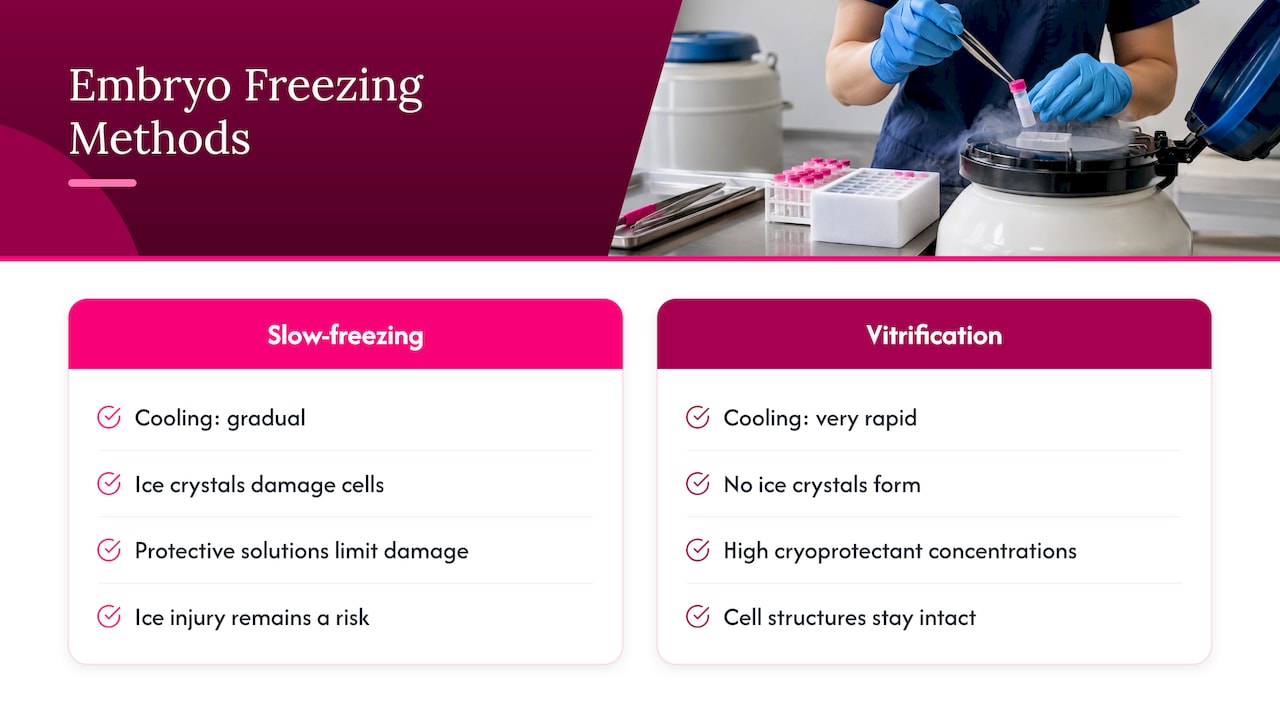
To understand why calendar time seems to matter so little, it helps to know what freezing actually does. Embryos are made largely of water, and ordinary freezing forms ice crystals that damage cells. Slow-freezing, the older approach, cooled embryos gradually and relied on protective solutions to limit that damage. It worked, but ice injury remained a risk.
Vitrification is the modern standard. Embryos are exposed to high concentrations of cryoprotectants for a very short time and then cooled so rapidly that the liquid turns into a glass-like solid instead of forming ice. Because there are no ice crystals, the cell structures stay intact, which is why vitrified embryos generally survive warming well.
Why stored embryos are effectively paused
Once vitrified, embryos are kept in liquid nitrogen (LN2) at about −196°C. At that temperature, vitrified material is highly stable, and biological time is effectively halted as long as the storage system stays undisturbed and well maintained. Chemical reactions that drive aging and degradation essentially stop. This is the core reason that years in storage are not expected to age an embryo the way years would age living tissue.
The important phrase is “as long as the storage system stays well maintained.” The embryo is only as stable as the environment around it, which is why laboratory quality control carries so much weight.
Laboratory safeguards that protect stored embryos
Professional guidance spells out what good cryostorage looks like. The ASRM committee opinion on cryostorage in the IVF laboratory recommends that laboratories monitor LN2 levels, either through frequent manual measurement or continuous monitoring. It also calls for documented thresholds that trigger a refill, written refill procedures, and spare or backup tanks (or reserved space) so specimens can be moved in an emergency. Inventory checks should be done in a way that minimizes how long specimens are exposed to warming.
In day-to-day terms, a well-run laboratory typically combines several layers:
- Continuous level and temperature sensors with alarms that reach staff after hours
- Automatic LN2 refill systems and a reserve supply on site
- Scheduled tank maintenance and inspection
- Documented inventory and witnessing procedures for every movement
What can go wrong, and how clinics reduce the odds
The realistic technical failure modes are few and well understood. A tank can lose its vacuum insulation, which causes LN2 to evaporate faster than expected. LN2 supply can run low if refills are missed. Contamination is a theoretical concern that laboratories address with sealed storage devices and handling standards. Each of these is managed through monitoring, redundancy, and a written response plan, rather than through luck.
What factors influence embryo outcomes over time?
If calendar time is not the main driver, what is? The research and clinical experience point to several variables that explain far more of the difference between one transfer and another.
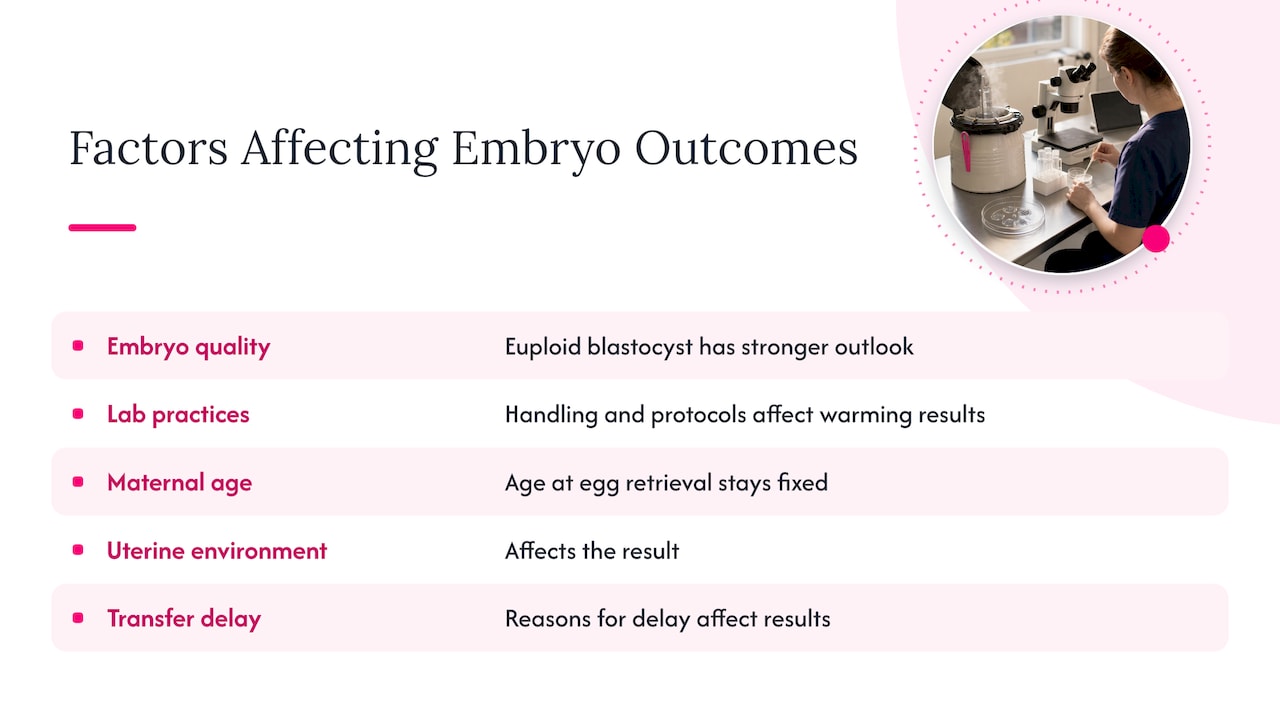
Embryo quality and stage at freezing. A well-developed blastocyst that, where testing was done, was found to be euploid starts with a stronger outlook than an untested lower-grade embryo. This starting quality travels with the embryo into storage and out again, regardless of how long it waited.
Laboratory skill. Freezing and warming are technical procedures. Differences in handling, protocols, and how survival is reported mean that two clinics can see different post-warming results from embryos of similar quality. This is one reason the clinic’s laboratory practices deserve as much attention as the storage duration.
Patient-level factors. Maternal age at the time of egg retrieval is a major determinant of embryo potential, and it stays fixed once the embryo is frozen. The uterine environment at transfer, any underlying conditions, and the reasons a patient delayed transfer all affect the result as well.
Why longer storage can look worse without being the cause
This is the point we most want you to take away. When a study finds that outcomes appear lower after longer storage, time itself is only one possible explanation, and often not the most likely one. Consider who tends to use embryos late. People often transfer their best-quality embryos first. Embryos left for later are, on average, the ones that were not selected initially, so a later transfer may draw from a lower-quality pool. Patients returning after many years may also have different circumstances than those transferring promptly.
That pattern is selection bias: the later group differs from the earlier group in ways unrelated to storage. The cohort data above fit this caution, since the authors noted small numbers and temporal differences in the long-storage group. It does not prove there is no time effect, but it explains why a raw comparison can overstate one. It also means that for an individual patient, embryo quality and age at retrieval are usually better guides than the number of years in the tank.
What are the practical storage rules, consent requirements, and fees?
Biology rarely sets the effective limit on embryo storage. Policy does. In the United States, there is no universal federally mandated time limit for embryo storage. Instead, clinics set their own protocols, which typically require periodic renewal of storage consent and payment of fees, with some policies asking for renewal every few years. Laws and rules can differ elsewhere, so patients outside the country should check their local requirements.
What “unclaimed” means and what ASRM recommends
The ASRM Ethics Committee opinion on unclaimed embryos recommends that clinics create, publish, and enforce written policies on how unclaimed embryos are designated, retained, and disposed of. It asks clinics to define what counts as “reasonable efforts” to reach the owners and a “reasonable period” before an embryo is considered unclaimed, and to obtain written disposition instructions at the time of cryopreservation.
In practice, an embryo may be classed as unclaimed after documented, repeated attempts to contact the owners fail and storage obligations go unmet. Clinics generally treat this as a last resort and spell out the steps in the consent paperwork you sign before freezing.
Common billing models for storage
Storage is usually billed in one of a few ways, and the model you choose affects both cost and flexibility. At Life IVF Center, our storage options are:
Missed payments are the most common route to an embryo being classed as unclaimed, so keeping your contact details current and responding to renewal notices matters as much as the fee itself.
What happens to embryos you no longer need
If you decide you will not use your remaining embryos, you generally have several options, each with its own ethical and legal safeguards:
- Directed donation to a specific person or couple
- Anonymous donation to others seeking to build a family
- Research donation, where permitted and consented to
- Discard, following the clinic’s documented procedure
These are personal decisions, and your written instructions on file should reflect what you actually want. We encourage patients to revisit them as circumstances change, rather than leaving the paperwork untouched for years.
What should you ask your clinic, and how do we protect stored embryos?
The strongest protection for stored embryos is a laboratory that treats storage as an active responsibility. Here is what we suggest you ask any clinic, including ours, before you commit:
- How often are LN2 levels checked, and are they monitored continuously with alarms that reach staff after hours?
- Is there an automatic LN2 refill system, and how much reserve supply is kept on site?
- What inventory and witnessing steps are used whenever an embryo is moved or verified?
- What are the written consent renewal and disposition policies, and when would embryos be considered unclaimed?
- How is storage billed, and what is the notice process before a missed payment has consequences?
- If a tank fails or a disaster is forecast, what is the plan to relocate specimens, and how will patients be told?
What a good emergency plan includes
SART/ASRM committee guidance on emergency planning advises clinics to keep LN2 monitoring in place, maintain duplicate records, and have protocols to top off or move tanks ahead of predicted disasters. It also advises notifying patients if specimens are moved or compromised. Duplicate remote records mean your embryo inventory can be reconstructed even if the main facility is unreachable.
Pro Tip: Bring your cycle records, your cryo ID numbers, and copies of every signed consent form to your consultation, and ask for any assurances about monitoring or emergency plans in writing.
What you can ask us about
Our approach is built around Precision IVF®, and our in-house laboratory gives our team direct control over how freezing and storage are handled. With multiple Southern California locations, we also support the logistics that come with treatment across sites. We are glad to walk you through our storage procedures, monitoring, and records practices in detail at a consultation.
Does storage time affect genetic testing and embryo selection?
Genetic testing results are tied to the embryo’s DNA at the time the biopsy was taken, and vitrified embryos are stable at storage temperature. For that reason, the information gained from a biopsy is generally not expected to lose accuracy simply because an embryo has been stored for longer. What matters more is the quality of the original biopsy, the testing laboratory’s methods, and the technology available when the test was run.
Testing methods do improve over time. A patient who tested embryos several years ago may wonder whether newer methods would give a different picture, and that is a reasonable question to raise with your care team. It does not mean the earlier result is wrong, but it may influence how you prioritize embryos for transfer.
Selection strategy is where storage time can quietly matter. Many patients transfer the embryo that ranks best on grade and testing first, leaving others for later. As discussed above, this can make later transfers look statistically weaker even when storage time is not the cause. If you hold embryos of different quality, discuss how your priorities, age, and family timeline should shape the order of transfers, and whether additional genetic testing options are appropriate for your situation.
What is it like emotionally to keep embryos in storage for years?
Embryos in a freezer are not only a clinical matter. For many people they represent a hoped-for child, a past treatment cycle, or a decision that is not yet ready to be made. Holding them for years can bring a mix of reassurance and unease, and both reactions are common.
Some patients feel comforted knowing that options remain open. Others feel pressure from the annual renewal notice, or guilt about being unsure whether to use, donate, or discard. Couples may see the question differently from one another, and circumstances such as a separation, a new partner, or a change in health can make the decision more complicated. Waiting for an emotionally right moment is understandable, and there is no single correct timeline.
A few steps can ease the weight. Talk openly with your partner about what you each want. Put your wishes in writing and update them when life changes. Ask your clinic whether counseling support is available, since speaking with a professional who understands fertility decisions can help you sort out what you feel from what you think you should decide. Choosing a billing option that fits your budget can also remove one source of stress, so that storage costs do not drive a decision that should be yours.
How we think about transfer timing versus continued storage
In our experience, the evidence points toward individualized planning rather than a fixed deadline. Because pooled data do not show a clear time-driven decline, there is rarely a biological reason to rush a transfer solely to beat the clock. At the same time, age at retrieval, embryo quality, your health, and your family timeline are real considerations, and for some patients an earlier transfer simply fits their goals better.
The trade-offs are practical. Transferring sooner can align with your family plans and limit ongoing storage costs. Delaying for medical, financial, or personal reasons is common and reasonable, and well-maintained storage supports that choice. The right answer comes from weighing these together with your care team, not from a single number. We encourage you to bring the checklist from the previous section to your consultation so your decision rests on specifics about the lab holding your embryos.
How to start with embryo freezing and secure storage at Life IVF Center
If you are ready to act, we can help you freeze embryos with a plan that suits your timeline. Our Precision Embryo Freezing is priced at $8,950 one-off, and our storage options (annual, 3-year prepaid, or monthly) are listed on our storage pricing page. To begin, book a consultation and bring your cycle records and any consent documents you already have. Our team will review your situation and answer your storage questions directly.
This article is general information, not a substitute for advice from a qualified doctor. Consult a qualified healthcare professional about your own circumstances before acting on anything here.
FAQ
What is the 14 day rule for embryos?
The research rule limiting embryo development in the laboratory does not set how long frozen embryos can be stored for fertility treatment.
Can you freeze an embryo for many years and still use it?
Yes, in many cases. Vitrified embryos held at about −196°C are effectively paused biologically, and a systematic review of extended storage noted case reports of successful live births after very long storage. Your clinic’s policies and consent renewals set the practical limit.
What happens if you don’t pay for embryo storage?
Your clinic’s consent paperwork spells this out. Under ASRM guidance on unclaimed embryos, clinics should have written policies defining reasonable efforts to reach owners before embryos are treated as unclaimed, so contact your clinic early if payment is a concern.
How much do you pay for embryo storage?
Costs vary by clinic and billing model. At Life IVF Center, storage is $750 per year, $2,000 for a 3 Year Prepaid plan, or $70 per month, as shown on our storage pricing page.
Is there a legal limit on how long embryos can be stored?
In the United States there is no universal federal time limit. Clinics set their own storage and consent renewal policies, so check yours.
Sources
- Storage Time of Cryopreserved Embryos and Pregnancy Outcomes: A Dose-Response Meta-Analysis
- The effect of extended cryo-storage following vitrification on embryo competence: a systematic review and meta-analysis – PMC
- Disposition of unclaimed embryos: an Ethics Committee opinion | American Society for Reproductive Medicine | ASRM
- Cryostorage of reproductive tissues in the in vitro fertilization laboratory: a committee opinion (2020) | American Society for Reproductive Medicine | ASRM
This article is for general educational purposes only and is not a substitute for personalized medical advice, diagnosis, or treatment. Fertility care is highly individual; please consult a qualified healthcare professional about your specific circumstances.
