
Current evidence does not support routine testing or suppression of natural killer (NK) cells to improve live birth rates for most people going through IVF. That is the short answer, and it holds up across the major systematic reviews on the subject, including a pooled 22-study analysis that found no consistent gap in live birth rates between women with elevated NK activity and those without.
Here is what that means for your next appointment:
- Ask before you test. If your clinic recommends an NK test, ask specifically how the result would change your treatment plan and whether it predicts live birth or only a proxy outcome like implantation rate.
- Question the source of the sample. A blood draw measures peripheral NK cells, not the tissue-resident cells in your uterine lining, and the two behave very differently.
- Treat immunotherapy offers with caution. Steroids, IVIg, intralipid, and similar add-ons carry real costs and, in some cases, real medical risk without proven benefit for most patients.
- Reasonable exceptions exist. Testing or therapy may make sense in a research protocol or after ruling out other causes of recurrent implantation failure, ideally with a reproductive immunologist guiding the conversation.
The Human Fertilisation and Embryology Authority and multiple peer-reviewed reviews back this cautious stance, and Life IVF Center’s Precision IVF® evaluations are built around that same evidence hierarchy rather than around add-ons with thin data behind them.
Key Takeaways
Uterine NK cells support implantation and placental development rather than threaten it, and no major meta-analysis has shown that testing or suppressing NK activity reliably improves live birth rates.
| Point | Details |
|---|---|
| uNK cells are not embryo threats | They make up the majority of decidual lymphocytes and support spiral artery remodeling during early pregnancy. |
| Blood tests don’t reflect uterine biology | Peripheral NK assays measure a different cell population and don’t correlate reliably with endometrial NK activity. |
| Evidence remains inconclusive | A 22-study meta-analysis found no consistent live birth difference tied to peripheral NK activity levels. |
| Immune add-ons carry real tradeoffs | Steroids, IVIg, intralipid, and similar treatments lack strong trial support and can carry cost or medical risk. |
| Rule out other causes first | Embryo quality, uterine anatomy, and endocrine factors should be evaluated before considering immune-focused testing. |
| Life IVF Center prioritizes sequencing | Precision IVF® evaluations start with established clinical factors before any immune-related discussion. |
Table of Contents
- What Uterine NK Cells Are and How They Differ From Blood NK Cells
- How Uterine NK Cells Are Measured and Where Testing Falls Short
- What the Research Says About NK Cells and IVF Success
- Do Immune Treatments for High NK Cells Actually Work?
- When Might NK Testing or Treatment Make Sense?
- Evidence-Backed Steps to Improve Your IVF Readiness
- Where NK Cell Research Is Headed Next
- Get an Evidence-Based Evaluation Before Any Immune Testing
- Sources
What Uterine NK Cells Are and How They Differ From Blood NK Cells
Uterine natural killer (uNK) cells are tissue-resident immune cells that support implantation and help remodel the blood vessels feeding the placenta. They are not embryo assassins waiting to attack a healthy pregnancy, a framing that persists in patient forums but does not hold up against current research. A 2024 review on NK cells in pregnancy directly addresses this myth, concluding that uNK cells are functionally supportive of placentation rather than hostile to it.
The confusion largely comes from conflating two very different cell populations that happen to share a name. Peripheral blood NK cells, the kind measured in a standard blood draw, are built for cytotoxic surveillance against infected or abnormal cells. Uterine NK cells are a distinct, tissue-adapted population with a different job description entirely.
Phenotype and function differ sharply between the two:
- Uterine NK cells predominantly have a CD56bright CD16 negative phenotype, which is associated with cytokine production and tissue remodeling rather than direct cell killing.
- Peripheral blood NK cells predominantly have a CD56dim CD16 positive phenotype, optimized for cytotoxic activity against foreign or damaged cells.
- Uterine NK cells express residency markers such as CD49a, CD9, and CD69, which anchor them to endometrial tissue and distinguish them from circulating immune cells.
- Their receptor profiles, including KIR, LILRB1, and NKG2A, are tuned to interact with trophoblast cells rather than to trigger generalized immune attack.
Timing matters here too. Uterine NK cell numbers rise through the secretory phase of the menstrual cycle, peak around the window of implantation, and remain abundant through early decidualization. During this window, they interact closely with invading extravillous trophoblast cells, cells from the developing placenta that burrow into the uterine lining to establish blood supply. That interaction helps remodel spiral arteries into wider, lower-resistance vessels capable of feeding a growing pregnancy. It is a cooperative process, not a hostile one, according to the uNK cell review synthesis that traces this biology across early pregnancy.
Pro Tip: If a clinic offers you a peripheral blood NK test to assess your uterine environment, ask what percentage of the tested cells resemble the CD56bright population that dominates the uterine lining. In most standard peripheral panels, it is a small minority, which is exactly why a blood result cannot substitute for what is happening in the endometrium.
The scale of this cell population inside the uterus is genuinely striking. Uterine NK cells account for the majority of lymphocytes in the decidua during early pregnancy (https://pmc.ncbi.nlm.nih.gov/articles/PMC9198966/), making them the dominant immune cell type at the maternal fetal interface. That dominance is not evidence of pathology. It reflects how central these cells are to a process, vascular remodeling, that a pregnancy cannot proceed without.

How Uterine NK Cells Are Measured and Where Testing Falls Short
Only endometrial or decidual tissue sampling directly measures uterine NK cells, and even that gold-standard approach carries meaningful limitations. Blood tests are more convenient, but convenience is not the same as clinical relevance when the cells you actually care about live in the uterine lining, not the bloodstream.
Three broad testing approaches exist, and they are not interchangeable:
Endometrial biopsy with immunohistochemistry (IHC) or flow cytometry
- Sample type: tissue taken directly from the uterine lining, typically during the window of implantation.
- What it measures: uNK cell density and, with newer multiplexed protocols, subtype distribution within the tissue itself.
- Main limitations: invasive, requires precise cycle timing, and results vary depending on lab technique and antibody panels used. A 2024 protocol paper describes multiplexed fluorescent IHC methods capable of distinguishing four uNK subtypes, but these remain specialized research tools rather than standardized clinical assays.
Menstrual blood testing
- Sample type: blood collected during menstruation, used as an indirect proxy for endometrial immune activity.
- What it measures: a mix of shed endometrial and immune cells, offering a non-invasive window into uterine biology.
- Main limitations: still experimental, without agreed reference ranges, and not yet validated against live birth outcomes.
Peripheral blood NK assays
- Sample type: a standard venous blood draw.
- What it measures: circulating NK cell counts and cytotoxic activity, reflecting general immune status rather than uterine conditions.
- Main limitations: does not correlate reliably with endometrial NK behavior, according to the HFEA, which explicitly states that peripheral testing does not provide useful information about the uterine immune environment.
There is no universally agreed threshold for what counts as a “high” uterine NK cell level. Different labs use different staining protocols, different cutoff percentages, and different timing windows within the cycle, which means a result flagged as abnormal at one clinic might read as unremarkable at another. Some commercial labs publish their own thresholds and offer repeat testing after treatment, but those cutoffs are not standardized across the field, a variability documented in a placenta laboratory protocol that outlines timing and follow-up recommendations used in practice.
Can I use a blood NK test instead of an endometrial test? No. A peripheral blood NK test measures a different cell population with a different job, and it will not tell you what your uterine lining is doing during the implantation window. If a clinic frames a blood test as a stand-in for uterine assessment, that is worth questioning directly, and Tommy’s patient information makes the same point in plain language for patients weighing this decision.
What the Research Says About NK Cells and IVF Success
Meta-analyses and systematic reviews consistently show inconsistent associations between NK cell measures and IVF outcomes, with no conclusive live birth benefit from testing or treating them. This is not a case of one lonely study swimming against the tide. It is a pattern that shows up across the strongest evidence available in reproductive immunology.
A few key findings shape the current picture:
- A 22-study pooled analysis found no consistent difference in live birth rates between women with elevated peripheral NK activity and those with normal levels, a result the review authors describe as heterogeneous and inconclusive across the fact vs. fiction meta-analysis.
- A review focused specifically on recurrent implantation failure and recurrent miscarriage found that some studies link elevated uterine NK numbers or altered subset balance to these conditions, while others find no such link, concluding that causation remains unproven despite years of investigation.
- The “First Do No Harm” review argues bluntly that there is no good evidence linking uNK cell behavior to miscarriage or implantation failure strongly enough to justify routine immunomodulation in standard IVF care.
Why does the research disagree with itself so often? A handful of recurring problems explain most of the inconsistency. Studies use different sample types, comparing peripheral blood in one trial to endometrial biopsy in another, which means they are not really measuring the same biological signal. Sample sizes tend to be small, often in the dozens rather than the hundreds, which makes it easy for chance findings to look like real patterns. Researchers also measure different outcomes: some track biochemical pregnancy or implantation rate, both of which are easier to move than the outcome that actually matters, a healthy live birth.
That last point deserves emphasis. Implantation rate and live birth rate are not the same thing, and a treatment that nudges the first number can still fail to move the second. Chemical pregnancies and early miscarriages happen for many reasons unrelated to immune status, so a study that stops measuring at the implantation stage can produce a misleadingly optimistic result.
Pro Tip: When your clinician cites a study supporting an NK-related test or treatment, ask one direct question: did this study measure live birth rate, or did it stop at implantation or clinical pregnancy? That single question filters out a large share of the studies used to market immune add-ons.
None of this means uterine NK biology is irrelevant to fertility. It means the leap from “uNK cells matter biologically” to “testing and adjusting them improves your odds” is not supported by the strongest available evidence yet. That gap between plausible biology and proven clinical benefit is exactly where a lot of unproven add-ons find their footing.
Do Immune Treatments for High NK Cells Actually Work?
Clinics offer a range of immune-focused treatments for patients flagged with “high” NK activity, but high-quality trial evidence supporting their use in IVF or recurrent pregnancy loss remains thin, and some of these interventions carry genuine risk. Here is how the most commonly offered options stack up.
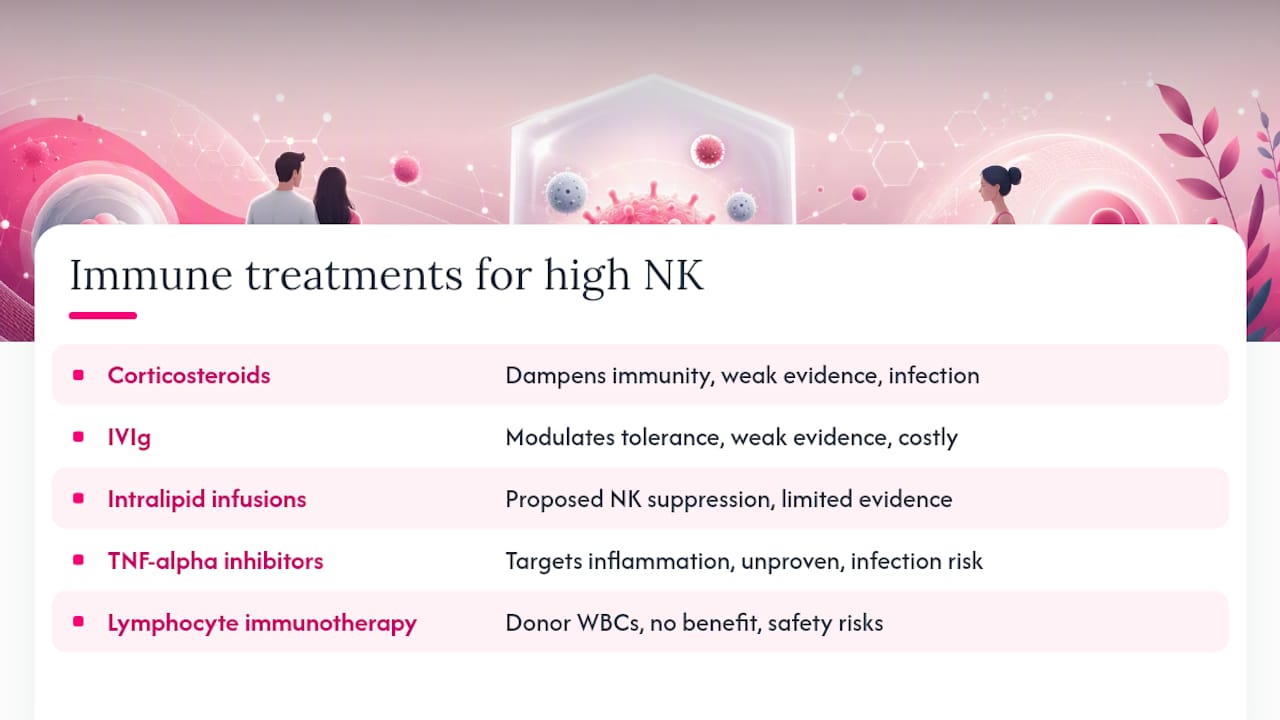
Corticosteroids (such as prednisone) are intended to broadly dampen immune activity around implantation. Trial evidence has not demonstrated a consistent live birth benefit, and prolonged steroid use carries risks including elevated blood sugar, mood changes, and increased infection susceptibility.
Intravenous immunoglobulin (IVIg) aims to modulate immune tolerance through infused antibodies. It is expensive, requires infusion visits, and systematic evidence has not shown it reliably improves live birth rates for unexplained recurrent implantation failure.
Intralipid infusions are marketed as an NK-suppressing lipid emulsion. The proposed mechanism lacks strong biological support, and controlled trial data showing a live birth benefit is limited at best.
TNF-alpha inhibitors target inflammatory signaling pathways. These drugs carry meaningful risks, including infection and, rarely, more serious immune complications, and are not established as safe or effective for routine fertility use.
Lymphocyte immunotherapy involves injecting a patient with partner or donor white blood cells to modulate immune tolerance. This approach has fallen out of favor in most reproductive medicine settings due to safety concerns and a lack of demonstrated benefit.
Granulocyte colony-stimulating factor (G-CSF) is used in some protocols to support endometrial receptivity. Evidence remains preliminary, and it is not established as a reliable fix for NK-related implantation concerns.
Across nearly all of these interventions, the pattern repeats: plausible-sounding mechanism, limited or inconsistent trial support, and real cost, whether financial or physical. The lack of consistent live birth benefit across studies and meta-analyses is one of the more stable findings in this entire field, echoed by the fact vs. fiction review covering peripheral NK activity specifically.
Growth in unproven immunomodulation for IVF has outpaced the evidence supporting it, and clinicians and patients should carefully weigh potential harms against uncertain benefits before pursuing these treatments. That caution is central to the “first, do no harm” framing used in one of the most widely cited reviews on this topic, which found no reliable evidence that uterine NK cells cause miscarriage or implantation failure severe enough to justify routine suppression.
A short list of red flags worth watching for: any clinic that guarantees a specific outcome from an immune protocol, any provider who recommends immunotherapy without first ruling out embryo quality or anatomical issues, and any treatment plan that skips informed consent about risks and evidence quality. If corticosteroids, IVIg, or TNF inhibitors are recommended, ask specifically about contraindications, since these medications are not risk-free for every patient, particularly those with a history of infection, uncontrolled diabetes, or autoimmune disease. Life IVF Center’s own review of immunotherapies in IVF walks through this evidence in more depth for patients weighing an add-on protocol.
When Might NK Testing or Treatment Make Sense?
Testing or immune therapy may be reasonable in select, well-defined circumstances, but usually only after other causes of implantation failure have been ruled out or within a formal research protocol. This is not a blanket dismissal of immune involvement in fertility. It is a call for sequencing: rule out the more common, better-understood causes first.
Before considering NK-focused testing, confirm the following have been evaluated:
- Embryo quality and genetic status, ideally through preimplantation genetic testing where clinically appropriate.
- Uterine anatomy, including fibroids, polyps, or scarring that could physically interfere with implantation.
- Endocrine factors such as thyroid function and progesterone support during the luteal phase.
- Chronic endometritis or other infections that can mimic immune-related implantation failure.
- Genetic factors in both partners when recurrent pregnancy loss has occurred multiple times.
If those areas come back clear and recurrent implantation failure or recurrent miscarriage persists, a conversation with a reproductive immunologist becomes more reasonable. Bring a short list of pointed questions:
- What specific test are you recommending, and what does it directly measure?
- What evidence links this test result to live birth outcomes, not just implantation rate?
- What are the risks and costs of any recommended treatment?
- Is this treatment offered within a research protocol, and if not, why not?
- What would you recommend if I decided not to pursue immune testing at all?
Pro Tip: If a clinic recommends a high-risk immunotherapy like IVIg or TNF inhibitors outside a research trial, ask whether a second opinion or enrollment in a formal study is available. A provider confident in the evidence should welcome that question rather than discourage it.
Evidence-Backed Steps to Improve Your IVF Readiness
For most IVF patients, more established parts of evaluation include embryo factors, uterine anatomy, endocrine health, and other findings supported by stronger clinical evidence.
- Request a thorough evaluation of embryo quality and, where appropriate, preimplantation genetic testing before assuming an immune cause.
- Ask about screening for chronic endometritis, since treating a low-grade infection can resolve implantation problems that might otherwise get misattributed to immune factors.
- Review thyroid function, progesterone support, and other endocrine factors with your clinician when clinically appropriate.
- Review lifestyle factors with documented impact, including smoking cessation, moderate weight management, and reducing alcohol intake before a cycle.
- Ask your clinic about uterine health strategies that are supported by outcome data rather than theoretical mechanisms.
Be wary of any protocol promising guaranteed results, or a one-size-fits-all immune add-on bundled into your treatment plan without an individualized rationale. Fertility care that works tends to be personalized to your specific findings, not applied uniformly across every patient who walks through the door.
Where NK Cell Research Is Headed Next
Promising research directions include uterine NK subset profiling, functional assays that go beyond simple cell counts, and controlled trials testing targeted immunotherapies, though clinical translation remains early. Simple counts have never told the full story, and the field is slowly shifting toward more nuanced tools.
- Multiplex immunohistochemistry is allowing researchers to distinguish multiple uNK subtypes within a single tissue sample rather than treating uNK as one uniform population, a method detailed in recent protocol work on four-subtype staining.
- Menstrual blood biomarkers are being explored as a less invasive alternative to endometrial biopsy, though validation against live birth outcomes is still in progress.
- Functional assays measuring what uNK cells actually do, rather than just how many are present, may eventually replace simple density counts as a more meaningful metric.
- Standardization efforts are underway to align sampling timing, staining protocols, and reporting thresholds across labs, addressing one of the field’s most persistent problems.
Translation into everyday clinical practice remains difficult because endometrial tissue is hard to access repeatedly, sample sizes in immunology trials tend to stay small, and ethical constraints limit how researchers can test new interventions on patients actively trying to conceive.
How We Assessed the Evidence
This article prioritizes peer-reviewed systematic reviews, meta-analyses, and clinical guidance bodies over individual studies or marketing claims, with live birth rate weighted as the outcome that matters most.
- Peer-reviewed systematic reviews and meta-analyses covering uNK biology, testing, and treatment outcomes.
- Clinical guidance from advisory bodies such as the HFEA, which evaluates fertility add-ons for evidence quality.
- High-impact basic science reviews explaining uNK cell function and phenotype.
- Live birth outcomes were prioritized over surrogate measures like implantation or biochemical pregnancy rates, since those endpoints can diverge significantly.
This article is intended for general education and does not replace individualized medical advice. Discuss your specific situation with a qualified reproductive endocrinologist or immunologist.
How Life IVF Center Approaches NK-Related Questions
Life IVF Center’s Precision IVF® approach starts with the patient’s clinical history, embryo information, uterine anatomy, and endocrine findings before considering an immune explanation for implantation difficulty.
If immune testing or therapy is considered, the discussion should include what the evidence does and does not show, potential risks, costs, alternatives, and the limits of current knowledge. No test result or add-on can guarantee an IVF outcome.
Get an Evidence-Based Evaluation Before Any Immune Testing
If you are weighing NK-cell testing or immune therapy, a broader diagnostic review is a reasonable first step. Life IVF Center’s Precision IVF® approach considers the full clinical picture before discussing optional add-ons.

Bring prior IVF records, embryo grading reports, endometrial biopsy results, and any immunology testing to your consultation. Life IVF Center can review these records and discuss which questions are supported by stronger evidence, which remain uncertain, and what next steps may fit your case.
Sources
This article is for general educational purposes only and is not a substitute for personalized medical advice, diagnosis, or treatment. Fertility care is individual; please consult a qualified healthcare professional about your circumstances. To discuss your options with our team, schedule a consultation with Life IVF Center.
Recommended
- Immunotherapies in IVF: What the Evidence Really Shows
- IVF and Surrogacy: What Patients Need to Know
- The Role of Genetics in IVF: What Patients Need to Know
- Immunology and Infertility: What You Need to Know
Ready to take the next step?
Life IVF Center specializes in individualized Precision IVF® care for complex cases—including diminished ovarian reserve, prior failed cycles, and advanced maternal age. Our in-house labs and dedicated physicians are ready to help.
Book a Free Consultation →