

If you or your partner carries a hereditary risk, the most important next step is to consult a fertility clinic that offers carrier screening, a certified genetic counselor (CGC), and coordinated preimplantation genetic testing for monogenic disorders (PGT-M). These three elements together give you real options, not just information.
Here is what to prioritize when scheduling that first consultation:
- Confirm the clinic has an ABOG-certified reproductive endocrinologist (REI) on staff.
- Ask whether a CGC is available on-site or through a formal genetics partnership.
- Verify the embryology lab holds CAP accreditation (not just CLIA certification).
- Request published lab metrics: blastocyst formation rate, freeze-thaw survival, and biopsy experience.
Life IVF Center offers Precision IVF® with integrated genetics services and is a recommended starting point for patients managing hereditary risks. You can review the IVF process at Life IVF Center before your first appointment.
Table of Contents
- What do carrier screening, PGT-M, and prenatal tests actually mean?
- Who should prioritize a genetics-focused fertility consultation?
- What are your options if one or both partners are carriers?
- How does the genetic testing process work, and what is the timeline?
- What do genetic testing and IVF for genetic issues typically cost?
- What can’t genetic tests promise? Limits you need to understand
- How do you choose the right fertility clinic for genetic issues?
- Why embryology lab quality and PGT-M test design drive outcomes
- Key Takeaways
- What genetics-focused care actually looks like in practice
- Life IVF Center coordinates genetic testing and IVF under one clinical team
- Useful sources
What do carrier screening, PGT-M, and prenatal tests actually mean?
Understanding the terminology before your first clinic visit saves time and helps you ask the right questions.
Carrier screening is a preconception blood or saliva test that checks whether one or both partners carry a gene variant associated with a hereditary condition, such as cystic fibrosis, spinal muscular atrophy, or sickle cell disease. Carriers typically have no symptoms themselves but can pass the variant to a child. Most reproductive endocrinologists recommend expanded carrier screening for all patients pursuing IVF, regardless of family history.
Prenatal diagnostic tests such as chorionic villus sampling (CVS), amniocentesis, and non-invasive prenatal testing (NIPT) are performed during pregnancy. They differ from preconception carrier screening and PGT in that they test the developing fetus directly, rather than the parents or embryos before transfer. NIPT screens fetal DNA circulating in maternal blood for chromosomal conditions like Down syndrome.
PGT types address different clinical questions:
- PGT-M (monogenic): Tests embryos for a specific single-gene disorder identified through carrier screening or family history. Requires a personalized test-design phase before the IVF cycle begins.
- PGT-A (aneuploidy): Screens embryos for extra or missing chromosomes to reduce miscarriage risk. Does not test for single-gene conditions.
- PGT-SR (structural rearrangement): Used when one partner carries a chromosomal rearrangement such as a translocation.
PGT is highly accurate for the specific changes it is designed to detect, but a low-risk result reduces rather than eliminates the chance of a genetic condition. Prenatal diagnostic confirmation remains the standard of care after any PGT cycle.
Who should prioritize a genetics-focused fertility consultation?
Not every fertility patient needs PGT-M, but several clinical profiles point clearly toward a genetics-aware clinic from the start.
- A known personal or family history of a single-gene disorder (cystic fibrosis, Huntington’s disease, fragile X syndrome, BRCA pathogenic variants, and similar conditions).
- A previous pregnancy affected by a genetic condition, or recurrent pregnancy loss where chromosomal causes have not been ruled out.
- One or both partners confirmed as carriers of the same autosomal recessive condition, or one partner carrying an autosomal dominant or X-linked condition.
- Ancestry groups with elevated carrier frequencies for specific conditions: Ashkenazi Jewish heritage and Gaucher disease or Tay-Sachs, for example, or African ancestry and sickle cell disease.
- Patients pursuing IVF who want to reduce miscarriage risk through PGT-A, or who need to test for a specific single-gene condition through PGT-M.
If any of these apply to you, bring that information to your first fertility consultation. A CGC can help interpret carrier results and explain what the risk figures mean for your specific situation before any treatment decision is made.

What are your options if one or both partners are carriers?
A genetics-aware fertility clinic can offer several distinct pathways, and the right one depends on the specific condition, carrier status of both partners, and your personal priorities.
IVF with PGT-M is the most direct route for couples where both partners carry the same recessive variant, or where one partner carries a dominant or X-linked condition. Embryos are biopsied at the blastocyst stage, tested for the specific mutation, and only unaffected or carrier embryos are transferred. This pathway requires the personalized test-design phase described later in this article.
Donor gametes offer an alternative when one partner’s genetic risk is the primary concern. Using donor sperm or donor eggs from a screened donor eliminates the transmission risk from that partner. Life IVF Center coordinates donor gamete and gestational carrier services for patients who choose this route.
Prenatal diagnosis after natural conception or IVF without PGT remains a valid option for some couples. CVS (performed around 10–13 weeks) or amniocentesis (around 15–20 weeks) can confirm whether a pregnancy is affected. Couples who have moral or personal objections to embryo selection sometimes prefer this approach.
Adoption or remaining child-free are choices some couples make after genetic counseling, particularly when the condition is severe and no other pathway feels right. A CGC can walk through all options without pressure.
Emotional and psychological support is an integral part of each pathway, not an afterthought. Reputable fertility clinics offer counseling referrals or on-site support, particularly when couples are weighing difficult decisions about embryo selection or donor use.
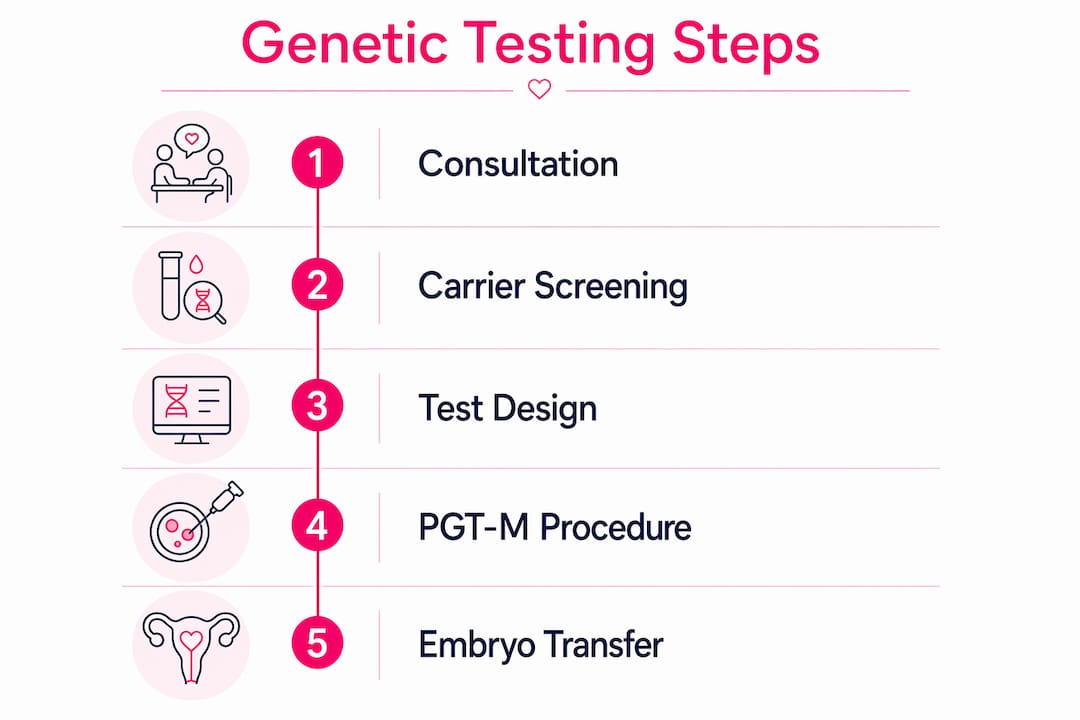
How does the genetic testing process work, and what is the timeline?
The process from first consultation to a result-ready embryo typically spans several months. Here is the step-by-step flow.
- Initial consultation with a reproductive endocrinologist (REI). The REI reviews your medical and family history, orders baseline fertility testing (ovarian reserve, semen analysis), and refers you to a CGC if a hereditary risk is identified.
- Genetic counseling session. The CGC reviews carrier screening results or family history, explains risk figures, and outlines which PGT type is appropriate. This session often happens in parallel with baseline fertility testing.
- Carrier screening and baseline fertility testing. Blood or saliva samples are collected. Most expanded carrier panels return results within 2–3 weeks.
- PGT-M test design (if applicable). This is the phase most patients do not anticipate. PGT-M requires a personalized test-design phase using DNA from the patient, partner, and sometimes other family members to track the specific inherited mutation and reduce inconclusive results from embryo biopsy. Test design typically takes 4–8 weeks.
- IVF cycle and embryo biopsy. Once the test is designed and the IVF cycle is timed, eggs are retrieved, fertilized, and cultured to the blastocyst stage (day 5 or 6). A few trophectoderm cells are biopsied from each blastocyst and sent to the genetics lab.
- Lab testing and results. Turnaround from biopsy to PGT result is typically 1–2 weeks. Embryos are frozen while awaiting results.
- Embryo transfer and prenatal confirmation. An unaffected embryo is transferred in a subsequent cycle. Prenatal diagnostic testing is recommended after a confirmed pregnancy.
What to bring to your first appointment:
- Prior genetic test results or carrier screening reports
- A written family history (at least three generations if possible)
- Insurance information and any prior authorization documentation
- A list of questions, including those about pre-IVF testing requirements
The overall timeline from first consult to a result-ready embryo often includes several weeks for test design, plus the IVF cycle. Planning for this upfront prevents surprises.
What do genetic testing and IVF for genetic issues typically cost?
Cost is one of the most common concerns for patients pursuing fertility treatment for genetic disorders, and the billing structure is more complex than a standard IVF cycle.
- Carrier screening panels: Expanded panels vary in scope and price. Some insurers cover diagnostic genetic testing when there is a documented family history or clinical indication.
- PGT-M test design: This is billed separately from the IVF cycle and the biopsy procedure. It is one of the most significant added costs in a PGT-M cycle.
- Embryo biopsy and genetics lab fees: The biopsy procedure and the external genetics lab analysis are often billed as separate line items.
- Genetic counseling: CGC sessions may or may not be covered under your plan, depending on whether the counselor is in-network.
- Embryo storage: Annual storage fees apply for frozen embryos awaiting transfer.
Clinic partnerships with external genetics labs can change both billing and turnaround time, and who is responsible for sample handling and quality control. Ask whether the genetics lab bills you directly or through the clinic.
Practical questions to ask at your consultation:
- “Do you bill the genetics lab separately, or is it bundled into the cycle fee?”
- “Will you provide a medical necessity letter for insurance preauthorization?”
- “What financial assistance or package pricing options exist for PGT cycles?”
For insurance guidance and preauthorization support, Life IVF Center’s prospective insurance patients page outlines what documentation the clinic can provide.
What can’t genetic tests promise? Limits you need to understand
Genetic testing is powerful, but it has real boundaries. Understanding those limits before you start protects you from misplaced certainty.
- Residual risk from carrier screening: A negative result on an expanded carrier panel significantly reduces risk but does not eliminate it. No panel tests for every known variant, and some rare variants are not included.
- Variants of uncertain significance (VUS): Carrier screening or PGT analysis sometimes returns a VUS, a variant whose clinical significance is not yet established. A VUS is neither a positive nor a negative result. Your CGC can explain what a VUS means for your specific situation and whether additional testing is warranted.
- Mosaicism: Some embryos contain a mix of chromosomally normal and abnormal cells. Because the biopsy samples only a few trophectoderm cells, it may not capture the full picture of the embryo’s chromosomal makeup.
- Biopsy limitations: The biopsy procedure itself carries a small procedural risk to the embryo. Ask any clinic you consider about their biopsy survival rates and how many PGT biopsies their embryologists perform annually.
- PGT reduces, not eliminates, risk: A low-risk PGT result does not guarantee a baby free of all genetic or chromosomal conditions. Prenatal diagnostic testing after a confirmed pregnancy remains the standard recommendation.
Pro Tip: Ask the clinic directly: “How do you handle a VUS or an intermediate PGT result? Do you recommend prenatal diagnostic confirmation after every PGT transfer?” A clinic that has a clear, documented protocol for ambiguous results is a clinic that has seen enough cases to develop one.
How do you choose the right fertility clinic for genetic issues?
The checklist below is designed specifically for patients where genetics is the primary concern. Use it when comparing clinics.
Credentials and staffing to verify:
- ABOG-certified REI on staff (verify at abog.org)
- CGC available on-site or through a formal, named genetics partnership
- Embryology lab holds CAP accreditation (not just CLIA certification)
- Clinic publishes or will share lab metrics: blastocyst formation rate, freeze-thaw survival, biopsy experience
Questions to ask at every clinic consultation:
- “Is your embryology lab CAP-accredited and CLIA-certified?”
- “Who designs the PGT-M test, and do you use family DNA for linkage analysis?”
- “What are your lab’s blastocyst formation and freeze-thaw survival benchmarks?”
- “Do you perform PGT biopsies in-house or send samples to a partner lab?”
- “Can you show age-group-matched, CDC-verified success rates for PGT cases specifically?”
Red flags to watch for:
- Refusal to share lab metrics or accreditation documentation
- Pressure to proceed with treatment before a full diagnostic workup is complete
- No CGC available and no formal genetics referral pathway
- Success rates presented without any case-mix context
Patients are advised to consult at least 2–3 clinics to compare approaches, communication, and published metrics before committing to treatment. Headline success rates are a starting point, not a decision criterion. Clinics that accept more complex genetic cases typically show different outcome statistics than clinics that select lower-risk patients, so comparing raw numbers across clinics without accounting for case mix leads to poor decisions. Prioritize lab quality and genetics experience above any single percentage.
For a practical list of questions to ask your fertility doctor, Life IVF Center has published a detailed guide that covers both clinical and logistical topics.
Why embryology lab quality and PGT-M test design drive outcomes
The embryology laboratory is where the outcome of your IVF cycle is largely determined, and for genetic cases, the PGT-M test design step is equally critical.
CAP accreditation is considered the gold standard for embryology lab quality. It goes beyond the federal CLIA requirements that all clinical labs must meet, requiring regular external inspections, proficiency testing, and documented quality management systems. A CAP-accredited lab has been independently audited in a way that CLIA alone does not require.
The metrics that matter most for genetic cases are specific and measurable:
| Lab Metric | Good Benchmark | Why It Matters for PGT Cases |
|---|---|---|
| Freeze-thaw survival | High rate | Embryos are frozen post-biopsy; low survival means fewer embryos available for transfer |
| Blastocyst formation rate | Moderate range | Higher rates mean more embryos reach the stage required for biopsy |
| Fertilization rate (ICSI) | Substantial rate | Baseline indicator of lab technique and gamete handling quality |
| PGT biopsy experience | Ask for annual volume | Higher volume correlates with lower procedural risk to embryos |
On the test-design side, a personalized PGT-M test built from family DNA reduces the risk of inconclusive or ambiguous results. Clinics that skip the family-DNA step have higher rates of ambiguous calls from embryo biopsy. The test-design phase uses DNA from the patient, partner, and sometimes a relative to build a linkage map around the specific mutation, so the lab can distinguish affected from unaffected embryos with greater confidence.
Pro Tip: Ask the clinic: “Do you perform routine CAP inspections, and can you share your most recent blastocyst formation and freeze-thaw survival rates?” A clinic confident in its lab will answer without hesitation. One that deflects or offers only national averages is telling you something.
Key Takeaways
Fertility clinics that offer carrier screening, CGC access, CAP-accredited labs, and coordinated PGT-M are the appropriate starting point for any patient managing a hereditary reproductive risk.
| Point | Details |
|---|---|
| Consult a genetics-aware clinic first | Prioritize clinics with a CGC on staff or partnered, an ABOG-certified REI, and CAP-accredited lab before any other factor. |
| PGT-M requires personalized test design | Family DNA is needed to build the test; plan for 4–8 weeks before the IVF cycle can begin. |
| Lab metrics are the real quality signal | Request published lab metrics: blastocyst formation rate, freeze-thaw survival, and biopsy experience. |
| PGT reduces but does not eliminate risk | Prenatal diagnostic confirmation is still recommended after every PGT transfer. |
| Life IVF Center offers integrated genetic services | Precision IVF® at Life IVF Center coordinates carrier screening, genetic counseling, and PGT for patients with hereditary risks. |
What genetics-focused care actually looks like in practice
Most articles about fertility clinics for genetic conditions describe what to look for in a clinic. Fewer address what it actually feels like to be a patient navigating this process, and where the real friction points are.
The hardest part for most couples is not the testing itself. It is the waiting period during PGT-M test design, when treatment is on hold while the genetics lab builds a personalized probe for your specific mutation. That 4–8 week window is emotionally difficult, and clinics that do not prepare patients for it create unnecessary anxiety. A clinic worth choosing will explain this phase at the first consultation, not after you have already started the process.
There is also a tendency in this space to present PGT-M as a near-guarantee. It is not. The test is highly accurate for the specific mutation it targets, but mosaicism, VUS results, and the limits of trophectoderm sampling mean that ambiguous outcomes happen. The clinics that handle these cases best are the ones that have clear protocols for ambiguous calls and that involve the CGC in the conversation from the start, not just at the beginning of the workup.
Finally, do not underestimate the value of a clinic that coordinates insurance documentation proactively. For patients with a documented genetic indication, some insurers will cover diagnostic testing or portions of the IVF cycle under a medical necessity framework. A clinic that routinely handles these cases will know how to write the preauthorization letter. One that rarely sees genetic cases will not.
Life IVF Center coordinates genetic testing and IVF under one clinical team
For patients managing a hereditary risk, the difference between a standard IVF clinic and a genetics-aware one is the difference between a referral and a coordinated plan. Life IVF Center brings both together.
Through Precision IVF®, Life IVF Center customizes every treatment protocol to the patient’s specific biological profile, medical history, and genetic findings. The clinic coordinates carrier screening, on-site or partnered genetic counseling, PGT-M and PGT-A testing, and donor gamete programs for patients who need an alternative pathway. Travel coordination, multi-language support, and insurance documentation assistance are available for patients coming from outside Southern California.
For your first genetics-focused consultation, bring prior genetic test results, a written family history, and your insurance information. The clinical team will review your history, connect you with a genetic counselor, and outline a clear plan before any treatment begins.
Schedule your genetics consultation at Life IVF Center and get a personalized plan that accounts for your hereditary risk from the first appointment.
Useful sources
- Life IVF Center: The IVF Process: step-by-step overview of the IVF process and what to expect at Life IVF Center
- Life IVF Center: Insurance for Prospective Patients: insurance guidance and preauthorization support
- Life IVF Center: The Role of Genetics in IVF: patient education on PGT-M and genetics in fertility care
- ASRM (American Society for Reproductive Medicine): professional guidance on PGT, carrier screening, and IVF protocols
- ACOG (American College of Obstetricians and Gynecologists): clinical practice guidelines on prenatal genetic testing and carrier screening
- NSGC (National Society of Genetic Counselors): directory and resources for finding a certified genetic counselor
- RESOLVE: The National Infertility Association: patient advocacy, emotional support resources, and insurance guidance
- SART (Society for Assisted Reproductive Technology): CDC-verified clinic success rate data by patient age and diagnosis
- ABOG (American Board of Obstetrics and Gynecology): verify board certification for reproductive endocrinologists
- MedlinePlus: NIPT: plain-language explanation of non-invasive prenatal testing
This article is general educational information, not medical or legal advice. Confirm your specific situation with an ABOG-certified reproductive endocrinologist and a certified genetic counselor before making any treatment decisions.
Recommended
- Blog – Life IVF Center
- Blog – Life IVF Center
- Your fertility evaluation checklist: Steps, tests, and benchmarks
- The Role of Genetics in IVF: What Patients Need to Know
Ready to take the next step?
Life IVF Center specializes in individualized Precision IVF® care for complex cases—including diminished ovarian reserve, prior failed cycles, and advanced maternal age. Our in-house labs and dedicated physicians are ready to help.
Book a Free Consultation →