
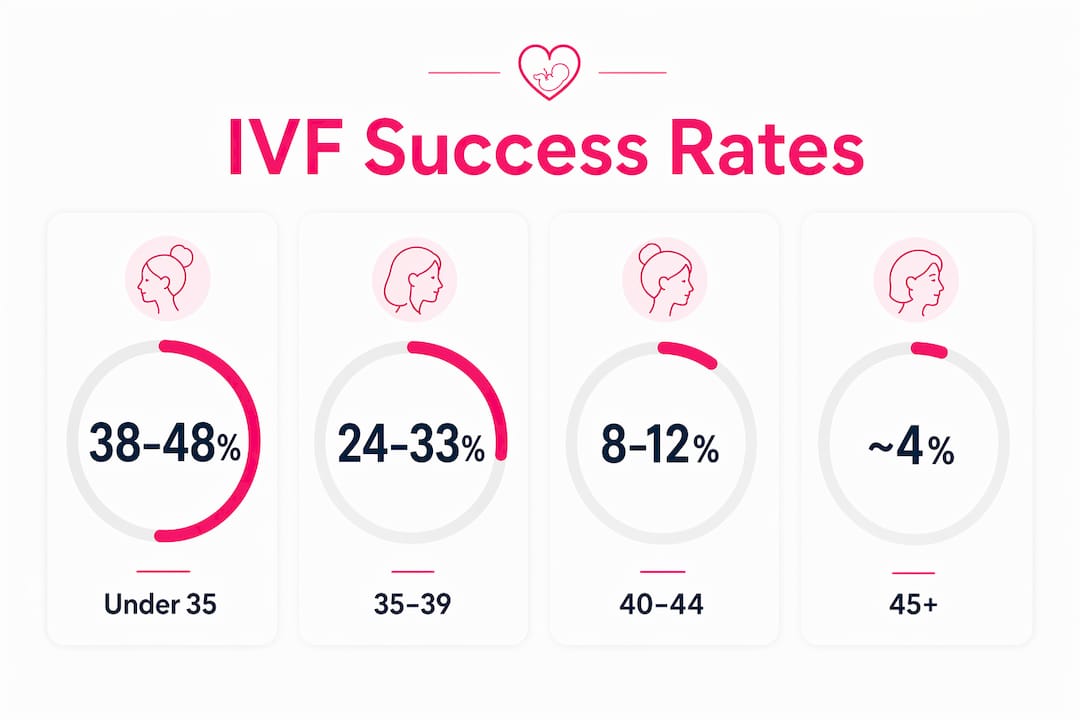
IVF success rates by age represent the most critical variable in fertility treatment planning. Women under 35 achieve live birth rates of approximately 38–48% per cycle, while women aged 43–44 see that figure fall to around 8%. These numbers come from large national datasets tracked by bodies such as the Human Fertilisation and Embryology Authority (HFEA) and the Society for Assisted Reproductive Technology (SART). Understanding where you fall in this data is not just reassuring. It is the foundation for every decision you will make about treatment timing, cycle planning, and whether options like donor eggs belong in your conversation.
How do IVF success rates change as women age?
Age is the single strongest predictor of IVF success, and the decline across age groups is steep. Live birth rates per embryo transferred sit at approximately 38% for women aged 18–34, and drop to just 8% for women aged 43–44. That is not a gradual slide. It is a cliff.
The table below summarizes live birth rates per cycle started and cumulative success over multiple cycles by age group:
| Age group | Live birth rate per cycle | Cumulative rate over 6 cycles |
|---|---|---|
| Under 35 | 38–48% | 79–85% |
| 35–37 | 28–35% | 60–70% |
| 38–40 | 18–26% | 45–55% |
| 41–42 | 10–15% | 30–40% |
| 43–44 | 8% | 14–20% |
| 45+ | Less than 5% | Less than 10% |

Cumulative rates matter because most patients do not succeed on the first cycle. Cumulative success over multiple cycles increases meaningfully with each attempt, especially for women under 40. A single cycle result does not define your outcome.
Cancellation rates also rise with age. Older patients are more likely to have cycles cancelled before egg retrieval due to poor ovarian response. This means the per-cycle figure you see in clinic brochures may overstate realistic chances for women in their early 40s, because cancelled cycles are sometimes excluded from reported data.
- Women under 35 have the highest probability of success per cycle and the best cumulative outcomes.
- Women aged 38–40 still have meaningful success rates but typically require more cycles.
- Women aged 41–44 face sharply reduced per-cycle rates and benefit most from early, proactive planning.
- Women over 45 using their own eggs have very limited success with IVF.
Pro Tip: Always ask your clinic for the live birth rate per cycle started, not per embryo transferred. Per-cycle rates give a more accurate picture of your realistic chances.
What causes age-related declines in IVF success?
The biological explanation is direct. Women are born with all the eggs they will ever have, and both the quantity and quality of those eggs decline with age. The decline accelerates after the mid-30s and becomes pronounced by age 40.
Egg quality is the central issue. As eggs age, they accumulate chromosomal errors. These errors prevent fertilization, cause embryos to stop developing, or lead to miscarriage. Women over 40 face a 3–6 times higher miscarriage risk due to chromosomal abnormalities. Miscarriage rates rise to approximately 40% at ages 40–44 and to 70% at age 45 and older.
Several biological factors drive this pattern:
- Diminished ovarian reserve: Fewer eggs are available for retrieval, reducing the number of embryos that can be created.
- Chromosomal abnormalities: Older eggs carry a higher rate of aneuploidy, meaning the wrong number of chromosomes. Most aneuploid embryos fail to implant or result in early pregnancy loss.
- Uterine environment: The uterine lining generally remains receptive across age groups, which is why donor egg recipients in their 40s can still carry pregnancies successfully.
- Embryo quality: Day-3 embryo quality can predict clinical pregnancy more precisely than age alone for women under 40, but age becomes the dominant factor beyond that threshold.
Biomarkers like anti-Müllerian hormone (AMH) measure egg quantity, not quality. AMH indicates ovarian reserve but does not reliably predict pregnancy outcomes on its own. A low AMH at 38 does not guarantee failure, and a normal AMH at 42 does not guarantee success. Male fertility factors also contribute. Sperm DNA fragmentation and motility issues affect fertilization rates and embryo development regardless of the woman’s age. A full assessment of male fertility factors belongs in every couple’s initial evaluation.
Pro Tip: Ask your reproductive endocrinologist for a full panel including AMH, antral follicle count (AFC), and FSH. No single marker tells the complete story.
How do donor eggs change outcomes for women over 40?
Donor egg IVF is the most effective way to address age-related egg quality decline. When a woman uses eggs from a donor who is typically under 35, the success rate reflects the donor’s egg quality, not the recipient’s age.
Donor egg IVF success rates per transfer reach 43–52% for recipients aged 40–44, compared to just 8–12% using their own eggs. For recipients aged 45–49, rates remain stable at 38–48% with donor eggs. These figures are among the most consistent in reproductive medicine.
| Recipient age | Own egg success rate | Donor egg success rate |
|---|---|---|
| 40–44 | 8–12% | 43–52% |
| 45–49 | Less than 5% | 38–48% |
The uterus, not the ovary, carries the pregnancy. Because the uterine environment remains functional well into the mid-40s for most women, donor egg recipients can achieve pregnancy rates that rival those of much younger patients using their own eggs. Life IVF Center offers a dedicated donor egg program with detailed guidance on what to expect at each stage of the process.
For patients who want to understand the full scope of donor egg IVF in 2026, including screening protocols and legal considerations, that resource covers the process in depth. Preimplantation genetic testing (PGT) is another adjunct that improves outcomes by screening embryos for chromosomal abnormalities before transfer, reducing miscarriage risk and increasing the probability of a healthy live birth.
What should patients over 35 know before starting IVF?
Planning IVF after 35 requires realistic expectations about the number of cycles, costs, and timing. The data is clear on one point: waiting reduces options.
-
Plan for multiple cycles. Many women over 35 need 2–3 cycles or more to achieve a live birth. Cumulative success rates are meaningfully higher than single-cycle rates, so one unsuccessful cycle does not mean IVF will not work for you.
-
Budget carefully. Medication and procedure costs can exceed $10,000–$15,000 per cycle. Financial planning that accounts for two or three cycles from the start reduces stress and avoids interrupted treatment.
-
Act without delay. Success rates fall sharply after age 35 and continue declining each year. Delaying treatment by even 12 months can meaningfully reduce your options, particularly between ages 38 and 42.
-
Understand obstetric risk. Pregnancies via IVF in women over 35 carry elevated risks including preeclampsia, gestational diabetes, and preterm birth, even in singleton pregnancies. These pregnancies should be managed as high-risk from the start.
-
Prioritize physical preparation. Nutrition, sleep, stress management, and avoiding smoking all affect egg quality and implantation. A fertility treatment timeline that includes a preparation phase before retrieval gives your body the best possible conditions.
Emotional support is not optional. The physical demands of IVF, combined with the uncertainty of outcomes, create significant psychological stress. Counseling, peer support groups, and open communication with your care team all improve the treatment experience and help patients stay engaged through multiple cycles.
Pro Tip: Request a consultation before you feel “ready.” Fertility assessments take time, and starting the evaluation process early gives you more options, not fewer.
Key Takeaways
Age is the most powerful predictor of IVF success, and understanding the data by age group is the first step toward making informed, timely decisions about treatment.
| Point | Details |
|---|---|
| Age drives success rates | Live birth rates drop from 38–48% under age 35 to around 8% at ages 43–44. |
| Cumulative rates matter | Women under 35 reach 79–85% success over 6 cycles; ages 43–44 reach only 14–20%. |
| Donor eggs change the equation | Recipients aged 40–44 achieve 43–52% success per transfer using donor eggs. |
| Timing is critical | Success rates decline each year after 35; early consultation preserves more options. |
| Multiple cycles are the norm | Most women over 35 require 2–3 cycles, making financial and emotional planning essential. |
What the numbers cannot tell you
Raw success rate data is the starting point, not the conclusion. I have seen patients in their early 40s achieve live births on the first cycle, and patients in their late 20s require four cycles and a protocol change before success. The data describes populations. Your outcome depends on your specific biology, your clinic’s protocols, and the decisions you make about timing and treatment.
What concerns me most is the number of patients who wait. They wait for the “right time,” for finances to align, or because one negative test discouraged them. Every month after 35 narrows the window. The shift from waiting to informed preparation is the single most consequential thing a patient can do. That means getting a baseline fertility assessment, understanding your AMH and antral follicle count, and having an honest conversation with a reproductive endocrinologist about what your numbers actually mean for your specific situation.
The data also does not capture the emotional weight of this process. Patients who understand the statistics going in tend to cope better with setbacks. They know a failed cycle is not a final answer. They know donor eggs are not a lesser option. They know that age-related fertility factors are real but not always determinative. Clear information, delivered with honesty and compassion, is the most useful thing a clinic can offer.
Personalized IVF care for women navigating age-related fertility challenges
Life IVF Center works with patients across Southern California who are facing exactly the challenges this data describes. The clinic’s Precision IVF® approach builds treatment protocols around each patient’s individual biological profile, including age, ovarian reserve, and medical history, rather than applying a one-size-fits-all cycle structure.
For patients who need multiple cycles or are considering donor eggs, Life IVF Center offers affordable treatment packages designed to support multi-cycle planning without financial uncertainty at every turn. The clinic’s donor egg program serves patients who want the highest possible success rates and a clear, supported path to parenthood. Scheduling a consultation is the most direct way to move from data to a plan that reflects your specific situation.
FAQ
What is the average IVF success rate for women under 35?
Women under 35 achieve live birth rates of approximately 38–48% per cycle started, with cumulative success reaching 79–85% over six cycles.
Does AMH predict IVF success?
AMH measures egg quantity, not quality. It does not reliably predict pregnancy outcomes on its own, and maternal age remains a stronger predictor of IVF success than AMH alone.
How much do donor eggs improve IVF success rates for women over 40?
Donor egg IVF success rates reach 43–52% per transfer for recipients aged 40–44, compared to just 8–12% using their own eggs at the same age.
How many IVF cycles does a woman over 35 typically need?
Most women over 35 require 2–3 cycles or more to achieve a live birth. Cumulative success rates increase with each additional cycle, so one failed attempt does not indicate treatment will not work.
When should a woman over 35 start the IVF process?
The earlier the better. Success rates decline each year after 35, and starting with a fertility assessment, even before committing to a full cycle, preserves more options and allows time for informed planning.
Recommended
- Age-Related Fertility Factors List: What You Need to Know
- Top 6 westcoastfertility.com Alternatives Providers 2026
- Top 6 westcoastfertility.com Alternatives Providers 2026
- IVF Process Explained: Personalize Your Path to Success
Ready to take the next step?
Life IVF Center specializes in individualized Precision IVF® care for complex cases—including diminished ovarian reserve, prior failed cycles, and advanced maternal age. Our in-house labs and dedicated physicians are ready to help.
Book a Free Consultation →