
Birth control pills are commonly used before IVF, but not universally, and the decision depends on your protocol, your ovarian reserve, and your clinic’s scheduling needs. Pretreatment typically serves one of three purposes: coordinating cycle timing, synchronizing follicles through temporary ovarian suppression, or preventing ovarian cysts before stimulation begins. Current fertility guidelines call for individualized decisions rather than a blanket rule for every patient.
TL;DR:
- Long GnRH agonist protocols often use three to four weeks of pill pretreatment; antagonist cycles use 12 to 21 days, while random start skips pretreatment.
- A Cochrane review found lower live birth or ongoing pregnancy rates with combined pill pretreatment in antagonist cycles than without it, though evidence quality varied.
- If ovarian reserve is diminished, ask about progestin type: a donor cohort linked more androgenic formulations to lower egg yields than no contraception or antiandrogenic formulations.
- Pills can temporarily lower AMH, so clinicians may delay or repeat testing after stopping; stimulation washout commonly lasts several days to a few weeks.
- Ask for a written medication calendar showing the pill stop date and stimulation start, especially when travel, work, or donor and recipient schedules complicate timing.
Table of Contents
- Why clinics prescribe birth control before some IVF cycles
- Common protocols that use pill pretreatment, and how long they run
- What the research says about outcomes, ovarian reserve, and oocyte yield
- Testing, AMH interpretation, and scheduling logistics
- Questions to ask your clinic about birth control before your IVF cycle
- Life IVF Center’s approach to pretreatment and individualized protocols
- Book a consult to review whether birth control pretreatment is right for you
- FAQ
- Sources
Why clinics prescribe birth control before some IVF cycles
Fertility clinics run on tight scheduling: lab availability, physician calendars, and in donor or recipient cycles, the coordination of two patients’ timelines at once. Birth control pills let us control exactly when a patient starts stimulation, which keeps cycles from colliding and keeps staffing predictable.
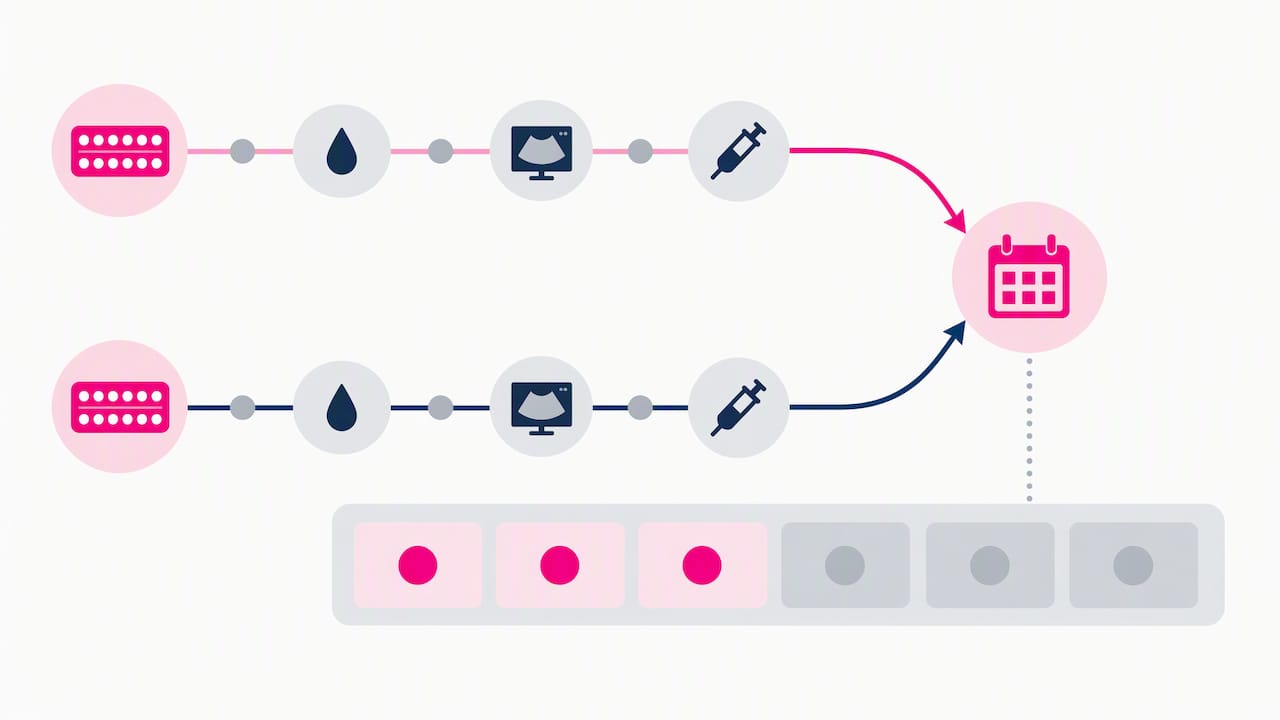
Beyond logistics, oral contraceptives suppress the ovaries temporarily. That suppression can synchronize the follicles recruited in the next cycle and reduce the chance of starting stimulation with a functional ovarian cyst already present, a situation that can delay or complicate the cycle.
Clinics use a few different pretreatment types depending on the goal:
- Combined oral contraceptives (estrogen plus progestin) for scheduling and cyst prevention.
- Progestin-only formulations, chosen selectively to limit androgenic exposure.
- Estrogen-only pretreatment, often used in antagonist protocols as a shorter alternative to a full pill pack.
Pretreatment is usually unnecessary when a patient has normal ovarian reserve and no scheduling conflict. In that situation, a random-start or immediate-start approach can skip pretreatment altogether, according to the ASRM Practice Committee Opinion on hormonal contraceptives in fertility treatments, which states that hormonal contraception can aid timing, reduce cyst risk, and support visualization before certain procedures, but should be decided on a patient-by-patient basis.
Common protocols that use pill pretreatment, and how long they run
The protocol you’re on largely determines whether you’ll take a pill before stimulation and for how long.
- Long GnRH agonist protocol. This approach typically pairs OCP pretreatment with a Lupron overlap, often running three to four weeks before the start of stimulation injections. The agonist and the pill work together to achieve deep pituitary suppression before follicle recruitment begins.
- GnRH antagonist cycles with OCP or estrogen scheduling. These usually call for a shorter pretreatment window, often 12 to 21 days of OCP or a brief course of estrogen, timed so stimulation starts on a predictable calendar day. A randomized trial comparing OCP and estrogen pretreatment in antagonist cycles found similar ongoing pregnancy and live birth rates between the two, with estrogen offering a shorter pretreatment duration.
- Random-start or immediate-start cycles. These skip pretreatment entirely and begin stimulation whenever the patient presents, regardless of calendar day. They’re common for fertility preservation and for patients with scheduling constraints that make a pretreatment window impractical.
Pro Tip: Ask your clinic for a written medication calendar before you start the pill, so you know exactly which day stimulation begins and which day you’ll stop the pretreatment.
What the research says about outcomes, ovarian reserve, and oocyte yield
The evidence on pretreatment outcomes is mixed, which is exactly why individualized decisions matter more than a fixed rule.
A Cochrane systematic review of pretreatments in IVF and ICSI cycles found that in antagonist protocols, combined oral contraceptive pretreatment was associated with a lower rate of live birth or ongoing pregnancy compared to no pretreatment, though the evidence quality varies across the included trials.
One cohort study found that hormonal contraceptives containing more androgenic progestins were linked to lower oocyte yields than no contraceptive use or anti-androgenic formulations, a finding from a retrospective cohort study of oocyte donors on hormonal contraception. That distinction matters for patients with diminished ovarian reserve, where every recruited follicle counts.
A few other findings round out the picture:
- A randomized trial in women with PCOS found that OCP pretreatment produced embryo quality that was noninferior to immediate start, though this applies specifically to that population and protocol design, per a randomized trial of OCP pretreatment in women with PCOS.
- Guideline bodies note that pretreatment is reasonable for scheduling convenience, but clinicians should weigh age, ovarian reserve, and protocol type against the outcome evidence before recommending it routinely.
- Updated HumReprod guidance on ovarian stimulation and pretreatment favors conditional, individualized recommendations over a one-size-fits-all approach.
None of this means pretreatment is wrong for most patients. It means the choice should reflect your ovarian reserve, your protocol, and your clinic’s read on your specific case rather than a default habit.
Testing, AMH interpretation, and scheduling logistics
Oral contraceptives can temporarily lower AMH and other ovarian reserve markers, which complicates baseline testing if you’re on the pill when labs are drawn. Clinicians sometimes delay AMH testing or interpret a lower result with caution, occasionally repeating it after a short washout rather than making an irreversible protocol decision on a single number.
A few practical points worth knowing before you start:
- A washout period of several days to a few weeks after stopping OCPs is common before stimulation begins, depending on protocol.
- Monitoring during stimulation may run slightly longer, and some patients on prior pretreatment need higher gonadotropin dosing to compensate for suppression.
- Cyst surveillance via ultrasound is typical at the baseline visit, especially after OCP pretreatment.
- If you’re coordinating a donor or recipient cycle, contraception timing often has to sync with a second patient’s calendar, which adds its own logistics. International surrogacy arrangements add another layer, and resources like how IVF timing coordinates with surrogacy programs outline how that coordination works in practice.
Pro Tip: If you’re traveling for treatment or juggling work obligations, ask for your pretreatment and stimulation dates in writing as early as possible. Small calendar shifts are easier to manage when you see the whole timeline up front.
Questions to ask your clinic about birth control before your IVF cycle
Walking into your consult with specific questions helps you leave with a clear plan rather than a list of unanswered concerns.
- Why is this specific pretreatment recommended for my case, and what would change that recommendation?
- What’s the exact medication, duration, and washout period before I start stimulation?
- How might this affect my AMH and other baseline labs, and when should those be drawn?
- Are random-start or immediate-start alternatives viable for me, and what are the tradeoffs?
- What happens if I have a contraindication to oral contraceptives?
| Question | Why it matters |
|---|---|
| Why this pretreatment, why now | Confirms the protocol fits your ovarian reserve and goals |
| Duration and washout | Sets expectations for your medication calendar |
| AMH timing | Avoids a baseline test skewed by hormone suppression |
| Alternatives available | Clarifies whether random-start fits your situation |
| Contraindications | Flags any need for a different pretreatment plan |
Life IVF Center’s approach to pretreatment and individualized protocols
We built our approach around the idea that pretreatment should fit the patient, not the other way around. Our team weighs ovarian reserve, protocol type, and scheduling needs before recommending birth control pills, and we avoid unnecessary suppression when a patient’s biology doesn’t call for it. If you’re wondering whether pretreatment applies to your case, that’s exactly the kind of question we walk through during a consult.
— Ben
Book a consult to review whether birth control pretreatment is right for you
A consult with our team covers your history, recent labs, and the protocol options that fit your ovarian reserve and timeline, including whether pretreatment makes sense for your cycle. You can review treatment package pricing and pre-IVF testing and panels ahead of your visit, and book a consultation when you’re ready to start.
Bring the following to your appointment:
- Your last menstrual period date.
- A list of current medications, including any hormonal contraceptives.
- Recent lab work, especially AMH, if you have it.
This article is general information, not a substitute for advice from a qualified doctor. Consult a qualified healthcare professional about your own circumstances before acting on anything here.
FAQ
Do you always take birth control before IVF?
No, birth control pretreatment isn’t used in every cycle. It’s typically prescribed for scheduling purposes, follicle synchronization, or cyst prevention, and clinics may skip it for patients with normal ovarian reserve or those using a random-start approach, according to the ASRM committee opinion on hormonal contraceptives.
What is the long agonist protocol in IVF stimulation?
The long agonist protocol pairs a GnRH agonist with pituitary suppression, often beginning after a course of oral contraceptive pretreatment that runs several weeks before stimulation starts. This protocol is designed to deeply suppress the pituitary gland before follicle recruitment begins, giving clinicians tighter control over cycle timing.
What is the 3 month pill rule?
There isn’t a standardized “3 month pill rule” recognized in major fertility guidelines; pretreatment durations described in the research typically run from about 12 days to a few weeks, not three months. If your clinic mentions a specific waiting period, ask them to explain the reasoning for your particular case.
What will disqualify you from IVF?
Disqualifying factors vary by clinic and depend on individual health findings rather than a fixed list, so this is a conversation to have directly with your care team. Pretreatment itself doesn’t disqualify a patient from IVF. It’s simply one scheduling and preparation tool among several that a clinic may or may not recommend based on your case.
Sources
- ASRM practice committee opinion: The use of hormonal contraceptives in fertility treatments (2024)
- Cochrane review: Pretreatments in IVF/ICSI cycles
- Randomized trial comparing OCP and estrogen pretreatment for scheduling in antagonist cycles
- ESHRE/HumReprod guideline updates on ovarian stimulation and pre-treatment (2025/2026)
This article is for general educational purposes only and is not a substitute for personalized medical advice, diagnosis, or treatment. Fertility care is highly individual; please consult a qualified healthcare professional about your specific circumstances.
