
Yes, IUI with donor sperm is a medically established option for building a family: it uses thawed, lab-prepared donor sperm timed to ovulation, and clinics follow FDA and ASRM screening and processing rules to reduce infectious and genetic risk. Success depends on age, uterine and tubal health, and sperm quality, and the pathway carries predictable costs and a manageable timeline that we can help you plan.
TL;DR:
- Donor sperm testing and quarantine requirements, especially for anonymous donors, often add about six months to the timeline, while directed donors require legal and testing steps that can extend planning by weeks or months.
- Clinics focus on a post-wash motile sperm count threshold of 0.75 million, with lower counts linked to significantly reduced pregnancy and live birth chances.
- Costs for donor sperm IUI include separate fees for clinic procedures, donor sperm vials, medications, and legal or legal-related expenses for known donors, with insurance coverage varying widely.
- For patients over age 40, or with tubal blockages or severe uterine conditions, moving directly to IVF might offer higher success probabilities and faster results than multiple IUI attempts.
Table of Contents
- The clinical pathway: from consultation to insemination
- Donor selection and screening: FDA and ASRM rules you should know
- Sperm preparation, motile counts, and how many vials to plan for
- What the evidence says about success with donor sperm IUI
- Cost and insurance: what a donor IUI cycle typically involves
- When IVF may be the better starting point
- A practical checklist and timeline for your first cycle
- How a specialty fertility clinic supports your donor sperm pathway
- Emotional and psychological support through the donor sperm process
- Fresh versus frozen donor sperm: what the difference means for you
- How your own health affects your odds with donor sperm IUI
- Risks and side effects to expect with donor sperm IUI
- How clinicians balance safety, timing, and your priorities
- Starting your donor sperm IUI journey with our clinic
- FAQ
- Sources
The clinical pathway: from consultation to insemination
Donor sperm IUI follows a sequence most patients can complete within one to two menstrual cycles once testing is underway. Knowing the steps in advance helps you ask sharper questions at your first visit and avoid delays later.
The initial evaluation usually includes:
- A review of medical history and a discussion of family-building goals, including whether you need an anonymous or directed donor.
- Ovarian reserve testing (AMH blood level and antral follicle count) to estimate how your ovaries are likely to respond.
- A hysterosalpingogram (HSG) when there is reason to check that at least one fallopian tube is open.
- Infectious disease screening for the recipient, since most clinics require this before any donor material is released for use.
Once testing clears, your clinician maps out a natural or medicated cycle. In a natural cycle, ovulation is tracked with bloodwork and ultrasound. In a medicated cycle, oral or injectable medications stimulate follicle growth, and monitoring visits become more frequent as insemination approaches. Either way, you can expect:
- Baseline bloodwork and an ultrasound early in the cycle to confirm a suitable starting point.
- Follow-up ultrasounds and hormone checks as a lead follicle matures.
- A trigger injection or a detected natural luteinizing hormone surge to time ovulation precisely.
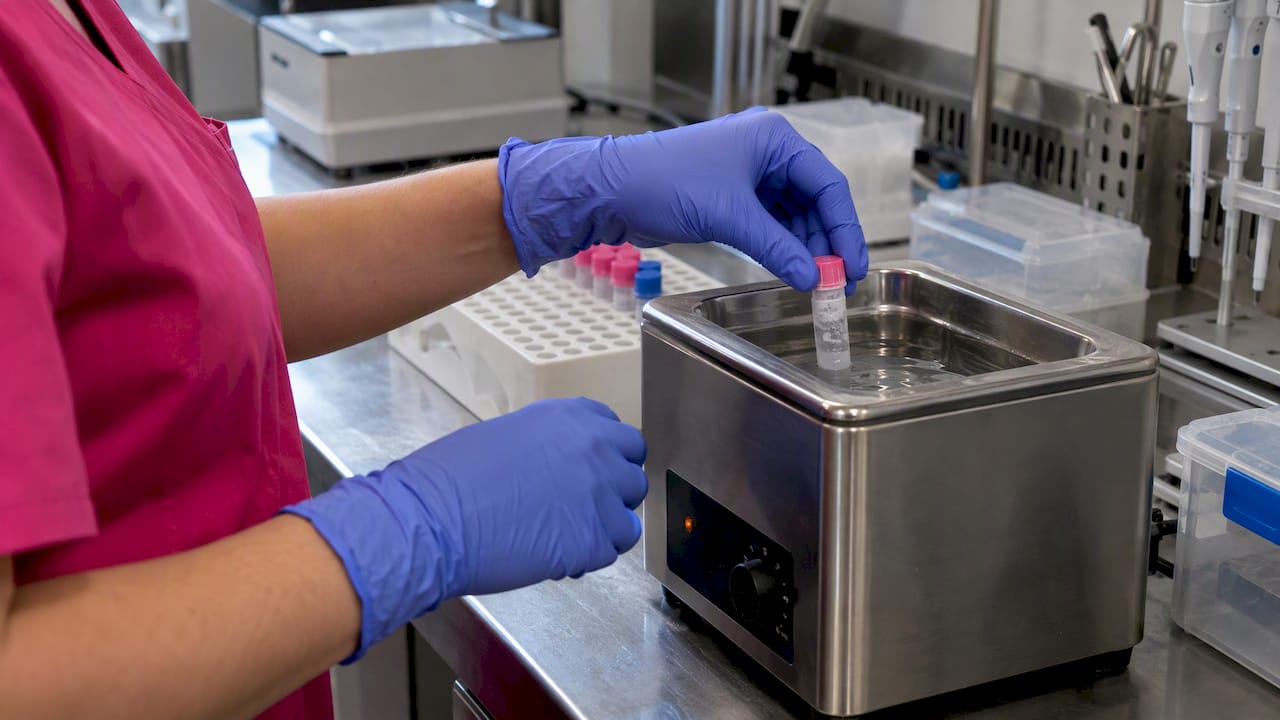
- Sperm thawing and washing on the morning of the procedure, which concentrates motile sperm and removes seminal plasma.
- The insemination itself, a brief in-office procedure using a thin catheter, followed by a short rest period before you leave.
The procedure itself takes only a few minutes and feels similar to a Pap smear for most patients. Mild cramping afterward is common and typically resolves within a day. From your first consultation to your first IUI attempt, most patients move through testing, donor selection, and cycle monitoring in four to eight weeks, faster for those using frozen vials from an established sperm bank, slower when directed-donor testing or additional diagnostic workups are needed.
Donor selection and screening: FDA and ASRM rules you should know
Donor sperm in the United States is governed by federal testing rules and professional guidance designed to minimize infectious and genetic risk, and understanding these rules helps explain both the safety of the process and the waiting periods involved.
- Nondirected (anonymous) donors must meet FDA eligibility and testing requirements, including infectious disease screening and a quarantine period, commonly around six months, before the sample is retested and released for use, according to ASRM guidance on gamete and embryo donation.
- ASRM practice guidance recommends genetic carrier screening and a psychosocial evaluation for donors beyond the infectious-disease testing the FDA requires, since these additions address inherited conditions and the emotional dimensions of third-party reproduction.
- Directed (known) donors, such as a friend or family member, still require FDA-mandated testing, but the timing can differ: directed donor samples may be used closer to collection in some circumstances, with retesting and quarantine practices varying by clinic and by state.
- Known-donor arrangements typically require legal consultation to document parental rights clearly, since state laws on parentage differ and informal agreements rarely hold up without a signed, attorney-reviewed contract.
These rules shape both cost and timeline. Anonymous donor sperm purchased from an established bank is usually already quarantined and ready to ship, which shortens your path to treatment. A directed donor requires new testing, possible quarantine, and legal paperwork before a single vial can be used, which can add weeks or months to planning.
Pro Tip: If you are considering a known donor, start the legal and testing process as soon as you confirm the arrangement. It almost always takes longer than patients expect.
Sperm preparation, motile counts, and how many vials to plan for
Donor sperm is frozen for storage and must be thawed and washed before it can be used in an IUI cycle. Washing separates motile sperm from seminal fluid and cellular debris, which both concentrates the sample and removes substances that can trigger uterine cramping if inseminated directly, a process described in procedural overviews from Mayo Clinic.
What matters most for your odds that cycle is not the vial count on paper but the post-wash motile sperm count actually available for insemination.
- Labs measure the total motile sperm count after washing, and this number, not the pre-freeze count, is what clinicians use to decide whether to proceed with that cycle.
- Some clinics will postpone or cancel an attempt if the post-wash count falls below an internal threshold, since lower counts are linked to lower success.
- Patients planning for more than one child with the same donor are often advised to reserve multiple vials early, since donor inventory can run out.
A retrospective study of 1,179 IUI cycles using donor sperm found that the number of motile spermatozoa inseminated was the only factor independently associated with both clinical pregnancy and live birth, with outcomes notably lower below a threshold of 0.75 million motile sperm used in the analysis. This single-center study reinforces why clinics track this number so closely rather than relying on donor-listed concentrations alone.
Banked frozen vials from a sperm bank arrive already processed for freezing and are generally straightforward to thaw on a predictable schedule. Fresh or directed-donor specimens require same-day coordination between the donor, the lab, and your monitoring appointments, which adds a logistical layer that frozen vials avoid.
What the evidence says about success with donor sperm IUI
Donor sperm IUI works for many patients, but published pregnancy rates are modest per cycle, which is why clinicians frame success in terms of cumulative attempts rather than a single try.
The same retrospective review of 1,179 IUI-D procedures reported a clinical pregnancy rate of 23.5% and a live birth rate of 18.9% per cycle. These per-cycle outcomes give a realistic baseline for what one attempt is likely to achieve, rather than what several attempts combined can produce.
Several factors shift those odds in either direction:
- Age and ovarian reserve are strong predictors. Younger patients with normal AMH and antral follicle counts generally see better per-cycle and cumulative outcomes than those with diminished ovarian reserve or advanced maternal age.
- Motile sperm count inseminated remains the clearest sperm-side predictor identified in the research above, which is why clinics monitor it so closely before proceeding.
- Tubal and uterine health matter: a blocked fallopian tube or significant uterine pathology can lower the odds that IUI succeeds at all, regardless of sperm quality.
- The number of mature follicles recruited in a medicated cycle also influences outcomes, though clinics balance this against the risk of multiple pregnancy.
National data add useful context. CDC and Am J Obstet Gynecol trend analysis found that donor sperm use in assisted reproductive technology increased in the United States between 1996 and 2014, accounting for about 6% of ART cycles by 2014, with outcomes broadly comparable to non-donor cycles once age was taken into account. That comparability matters: donor sperm itself is not typically the limiting factor in success, the recipient’s own reproductive biology usually is.
When reviewing your own odds with a clinician, ask whether the numbers being discussed are per-cycle or cumulative across several attempts.
Cost and insurance: what a donor IUI cycle typically involves
Donor sperm IUI involves several separate line items rather than one flat fee, and understanding each piece helps you budget accurately and avoid surprises.
A typical cycle includes the clinic’s monitoring and procedure fee, the cost of purchasing one or more donor sperm vials from a sperm bank (billed separately from the clinic), medication costs if you use a stimulated cycle, and any diagnostic testing completed beforehand. At Life IVF Center, pre-cycle testing such as an infectious disease panel, sperm count, and related diagnostics are priced individually, which lets you see exactly what each test costs rather than absorbing it into a bundled estimate.
- Directed-donor pathways add costs that anonymous donor cycles do not, including donor testing fees and a legal consultation to document parental rights.
- Patients planning for future siblings with the same donor often purchase and store multiple vials upfront, since some donors sell out of inventory over time.
- Insurance coverage for fertility treatment varies widely by state and by employer plan, and many plans exclude donor gamete purchase even when they cover procedure costs, so verifying your specific benefits early avoids mid-cycle surprises.
- Some patients pay out of pocket for the full cycle, while others combine partial insurance coverage with self-pay for excluded items like donor sperm purchase or storage.
Pro Tip: Call your insurance plan directly and ask specifically whether donor gamete purchase, IUI procedure fees, and monitoring are each covered. These are often billed and adjudicated separately.
For patients planning multiple attempts, packaged pricing and multi-cycle bundles can reduce the per-cycle cost compared to paying for each visit individually, and financing options are worth discussing with your clinic’s financial counselor before your first cycle begins.
When IVF may be the better starting point
IUI with donor sperm is not the right first step for every patient, and recognizing the signs early can save time and emotional strain.
- Advanced maternal age, particularly for patients over 40, often comes with lower per-cycle IUI success, making IVF’s higher per-cycle odds a faster route to pregnancy.
- Bilateral tubal occlusion makes IUI ineffective altogether, since the procedure depends on at least one open fallopian tube to allow fertilization to occur naturally inside the body.
- Significant uterine disease, such as large fibroids distorting the cavity or severe endometriosis, can lower IUI success enough that IVF becomes the more time-efficient option.
- Repeated failed IUI cycles, generally three to four attempts without pregnancy, prompt most clinicians to recommend reevaluating the plan rather than continuing indefinitely.
Clinics weigh AMH, antral follicle count, HSG results, and prior cycle outcomes together when advising a patient on whether to continue with IUI or move to IVF. Age and timeline pressure also factor into this conversation: patients closer to 40 often have less room to spend multiple cycles on a lower-probability approach, and that reality is worth discussing openly with your care team rather than deferring the decision.
A practical checklist and timeline for your first cycle
Preparing ahead of time keeps a donor sperm IUI cycle from stalling on paperwork or testing delays.
- Complete recipient screening (infectious disease panel, pelvic exam, and any imaging your clinician recommends) before your cycle start date.
- Select and reserve your donor sperm vials, or begin directed-donor testing and legal documentation, at least four to six weeks before your intended cycle.
- Confirm insurance coverage details in writing, including what is and is not covered for donor gamete purchase and procedure fees.
- Attend your baseline monitoring visit (bloodwork and ultrasound) in the first few days of your cycle.
- Follow your clinic’s monitoring schedule, typically two to four visits over 7 to 12 days, to track follicle growth and time the trigger or ovulation surge.
- Arrive for insemination on the scheduled day, when the lab thaws and washes the donor sample shortly before the procedure.
- Schedule a pregnancy test roughly two weeks after insemination, and discuss next-cycle planning in advance in case this attempt does not succeed.
A medicated cycle often looks like this: cycle day 2 or 3 baseline bloodwork and ultrasound, days 5 through 10 taking stimulation medication with one or two monitoring visits, a trigger injection once a lead follicle matures, insemination 24 to 36 hours later, and a pregnancy test about 14 days after that. Natural cycles follow a similar shape without the stimulation medication, usually with slightly fewer monitoring visits.
Pro Tip: Book your donor vial or begin known-donor testing before your cycle starts, not after. Vial shipping and quarantine-related delays are among the most common reasons a planned cycle gets pushed back.
How a specialty fertility clinic supports your donor sperm pathway
Coordinating a donor sperm IUI cycle involves more moving parts than a standard fertility visit, from donor logistics to testing timelines to legal paperwork for known donors, and a clinic built around this kind of care can keep those pieces aligned instead of leaving you to track them separately.
At Life IVF Center, the services most relevant to a donor sperm pathway include:
- Intrauterine Insemination (IUI) alongside donor program coordination, so vial selection, shipping, and cycle timing are managed under one roof.
- Genetic testing and counseling support for patients who want additional screening beyond standard donor bank disclosures.
- In-house laboratory capabilities, which allow sperm thawing, washing, and quality checks to happen without sending samples to an outside facility.
- Travel coordination and financial guidance for patients traveling from outside the immediate area or weighing payment and insurance options.
- Precision IVF®, our individualized approach for patients who move from IUI to IVF, built around each patient’s own biology and history rather than a one-size protocol.
A specialty clinic setting matters because donor logistics, legal documentation for known donors, and the testing cadence required by FDA and ASRM guidance all intersect. Having one coordinated team manage these threads reduces the chance that a missed test or an expired quarantine window delays your cycle.
Emotional and psychological support through the donor sperm process
Choosing donor sperm often brings up feelings worth acknowledging openly rather than setting aside. Grief over genetic connection, questions about disclosure to a future child, and uncertainty about how to talk with family members are common and do not indicate anything is wrong with your decision.
Many patients find a licensed mental health counselor who specializes in third-party reproduction helpful, both before starting treatment and during the waiting periods between cycles. ASRM-recommended psychosocial evaluation for donors reflects a broader recognition in the field that counseling support benefits recipients as well, not only donors. Support groups, whether in person or online, connect patients with others who have navigated similar decisions, and many find it easier to process the emotional weight of donor conception alongside people who understand the specific questions involved, such as how and when to tell a child about their conception.
If you are partnered, consider scheduling at least one counseling session together, since partners sometimes process the decision to use donor sperm differently, particularly around questions of genetic connection. Single patients by choice often benefit from connecting with other single parents by choice, since some of the practical and social questions that arise are specific to that path. Your clinic can typically provide referrals to counselors experienced in donor conception if you do not already have one.
Fresh versus frozen donor sperm: what the difference means for you
Nearly all donor sperm used in IUI today is frozen, and understanding why clarifies what to expect from the process. Frozen sperm allows for the FDA-required quarantine and retesting period that reduces infectious disease risk, which is not possible with a fresh sample used immediately after collection, as described in ASRM’s guidance on gamete donation.
Frozen donor sperm from an established sperm bank arrives already screened, quarantined, and ready to thaw on your clinic’s schedule, which gives you flexibility in timing your cycle around monitoring appointments rather than around a donor’s availability. Clinical overviews note that freezing and thawing does reduce sperm survival somewhat compared to a fresh sample, which is part of why post-thaw motile counts, not pre-freeze counts, are what matter for planning your cycle.
Fresh sperm is more common in directed-donor arrangements, particularly when a known donor is available to provide a sample close to the time of insemination. However, even directed donors are usually required to complete FDA-mandated testing, and depending on the arrangement and state requirements, some clinics still prefer a quarantine and retest period before use, which narrows the practical difference between fresh and frozen in a clinical setting. The key takeaway is that the testing and quarantine framework, not simply the fresh versus frozen label, is what governs safety and timing in a donor sperm cycle.
How your own health affects your odds with donor sperm IUI
Donor sperm quality is only one half of the equation. Your own reproductive health, independent of the sperm source, has a substantial influence on whether an IUI cycle succeeds.
Ovarian reserve, measured through AMH levels and antral follicle count, shapes how your body responds to stimulation and how many mature eggs are available during the fertile window. Tubal patency matters just as much: IUI relies on at least one open fallopian tube to allow sperm to reach an egg, so an HSG is often recommended before your first cycle if your tubal status is unknown. Uterine conditions such as fibroids, polyps, or scarring can interfere with implantation even when fertilization occurs successfully.
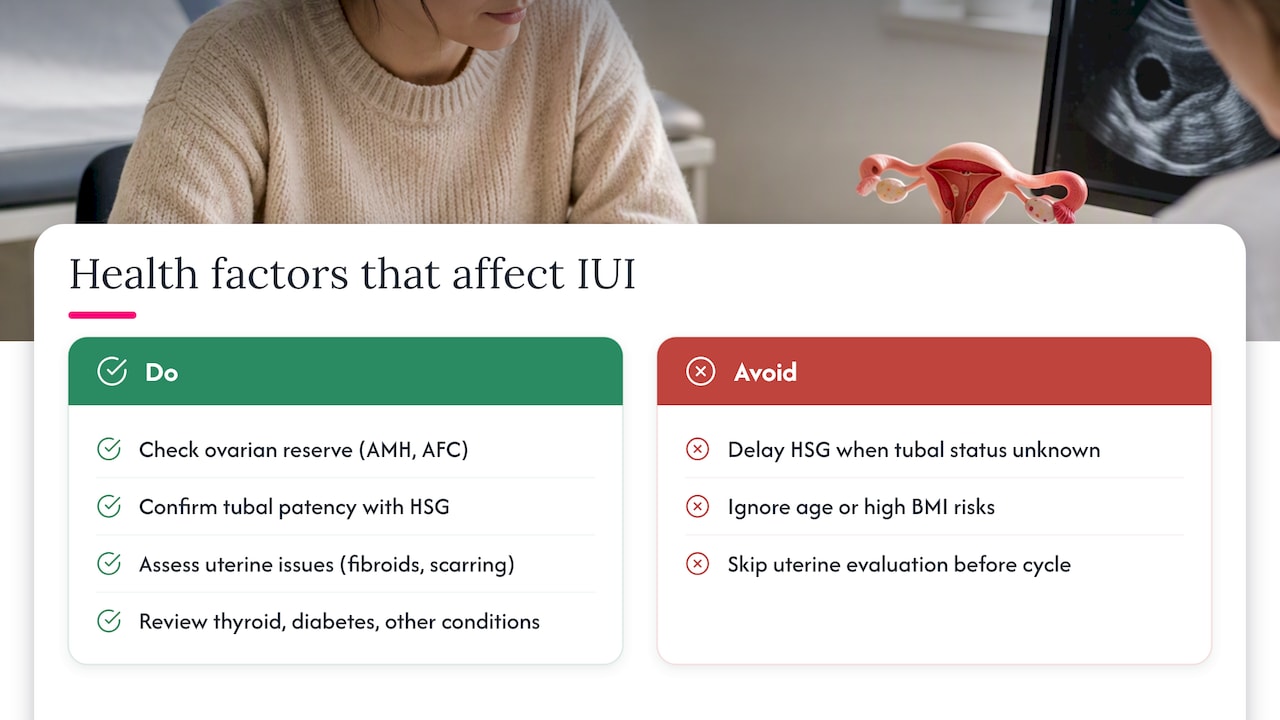
A retrospective institutional review of patients using donor sperm across IUI and IVF found that pregnancy complications were more likely among older patients and those with elevated BMI, a reminder that recipient health factors extend beyond fertility testing alone into pregnancy outcomes once conception occurs. That same review found live birth rates were higher with IVF than IUI in that cohort, reinforcing why clinics weigh recipient-specific factors carefully when recommending one pathway over the other. Thyroid function, uncontrolled diabetes, and other chronic conditions can also affect both conception and early pregnancy, which is why a thorough pre-cycle health review is a standard part of preparing for donor sperm IUI rather than an optional add-on.
Risks and side effects to expect with donor sperm IUI
IUI with donor sperm is generally well tolerated, and the risk profile is similar to IUI using partner sperm since the procedure itself does not change based on sperm source.
Mild cramping during or shortly after the procedure is common and usually resolves within a day, caused by the catheter passing through the cervix rather than by the donor sperm itself. Light spotting afterward is also common and not typically a cause for concern. Washing the sperm sample before insemination, which clinical procedural overviews describe as standard practice, removes seminal plasma that could otherwise cause stronger uterine cramping or an immune reaction if inseminated unwashed.
If you use a medicated cycle with stimulation medication, there is a modest risk of multiple pregnancy (twins or more), since stimulation can mature more than one follicle in a cycle. Your clinic will monitor follicle development closely and may cancel or convert a cycle if too many mature follicles develop, specifically to reduce this risk. Ovarian hyperstimulation, a more serious reaction to stimulation medication, is uncommon with the milder protocols typically used for IUI compared to IVF, but your monitoring visits are designed to catch early signs if they appear. Infection following the procedure is rare given the sterile technique used and the rigorous donor screening required by FDA regulations, which is one of the central reasons those testing and quarantine rules exist in the first place.
How clinicians balance safety, timing, and your priorities
Clinicians weigh regulatory testing requirements against the understandable urgency patients feel, and the honest answer is that safety rules are rarely the bottleneck they appear to be. Quarantine periods for anonymous donors exist because they measurably reduce infectious risk, not to create delay for its own sake.
For directed donors, clear consent and legal documentation protect everyone involved, including the resulting child’s legal parentage, which is why we encourage addressing it early rather than treating it as a formality. The honest clinical stance is that no single protocol fits every patient: your age, your donor choice, and your own health history should shape your specific plan, not a generic checklist.
— Ben
Starting your donor sperm IUI journey with our clinic
If you are ready to move forward, we coordinate the testing, donor logistics, and monitoring that donor sperm IUI requires, so the process feels organized rather than scattered across separate providers.
Before your first consultation, it helps to bring a record of any prior fertility testing, a list of current medications, and your thinking on anonymous versus directed donor options, even if that thinking is still in progress. Our team can walk you through:
- Pre-cycle testing options, including the infectious disease panel, sperm count, and other diagnostics priced individually so you know exactly what each step costs.
- Donor vial logistics and storage planning if you are considering more than one future cycle or sibling.
- Financial coordination, including how packaged pricing works for IVF and related treatment packages if your plan shifts from IUI to IVF.
- Multi-language support for patients and partners who are more comfortable discussing care in a language other than English.
We also support patients who are exploring Precision IVF® as a next step if IUI does not lead to pregnancy after several attempts, with treatment plans built around your own biology rather than a standard protocol. To get started, book a consultation and bring your questions. Our team will help you map out a realistic plan from your first visit forward.
This article is general information, not a substitute for advice from a qualified doctor. Consult a qualified healthcare professional about your own circumstances before acting on anything here.
FAQ
Can IUI be successful with donor sperm?
Yes, IUI with donor sperm is a standard and effective option for many patients, though success varies by individual factors. A retrospective study of 1,179 cycles reported a 23.5% clinical pregnancy rate and an 18.9% live birth rate per cycle, with motile sperm count as the strongest predictor of outcome.
How expensive is IUI with donor sperm?
Costs include separate line items: the clinic’s monitoring and procedure fee, the donor sperm vial purchased from a sperm bank, and any medications or pre-cycle testing. At Life IVF Center, individual pre-cycle tests such as an infectious disease panel and sperm count are priced separately, and your clinic’s financial counselor can walk through a full estimate based on your specific plan.
What are the odds of getting pregnant with donor sperm?
Per-cycle odds depend heavily on age, ovarian reserve, and the motile sperm count used in the insemination. Published data from a large single-center study show a per-cycle live birth rate of 18.9%, and clinics typically discuss cumulative probability across several cycles rather than judging success on one attempt alone, based on findings from this retrospective review.
Will my baby look like me if I use donor sperm?
A child conceived with donor sperm shares half their genetic material with the birthing parent, so physical resemblance to that parent is entirely possible, though traits from the donor will also appear. Many sperm banks allow you to review donor physical characteristics, such as hair color, eye color, and build, when selecting a donor, which can inform your choice if resemblance matters to you.
What is the difference between using a known donor and an anonymous donor?
Anonymous (nondirected) donors go through standardized FDA testing and quarantine before release, while known (directed) donors require the same FDA-mandated testing but typically also involve legal consultation to document parental rights clearly. Directed donor arrangements can take longer to arrange due to testing and legal paperwork, according to ASRM guidance on gamete donation.
Sources
- Intrauterine insemination with donor sperm
- Guidance regarding gamete and embryo donation, ASRM
- Assisted reproductive technology with donor sperm: national trends and perinatal outcomes
- Intrauterine insemination (IUI) – Mayo Clinic
This article is for general educational purposes only and is not a substitute for personalized medical advice, diagnosis, or treatment. Fertility care is highly individual; please consult a qualified healthcare professional about your specific circumstances.
