
Hydrosalpinx is associated with lower implantation and clinical pregnancy rates in IVF, and treating or isolating the affected tube before embryo transfer is generally recommended when it is feasible. Surgical options, salpingectomy or tubal occlusion, show the most consistent benefit in clinical research. When surgery is not possible, ultrasound-guided aspiration or sclerotherapy may be considered, though fluid tends to come back more often with these approaches.
TL;DR:
- Surgery, such as salpingectomy or tubal occlusion, significantly improves IVF pregnancy rates by removing or isolating the problematic hydrosalpinx.
- Aspiration is less invasive but often leads to fluid reaccumulation in about one-third of cases, which may reduce its effectiveness.
- Timing of treatment matters: performing surgery before IVF or after egg retrieval yields similar pregnancy chances but affects costs and recovery periods.
- Surgical technique, especially preserving ovarian blood supply, influences future ovarian response and should be carefully discussed with the surgeon.
- Conservative management might be appropriate for small or unilateral hydrosalpinx but generally reduces chances of pregnancy if left untreated.
Table of Contents
- Why hydrosalpinx lowers IVF success: mechanisms and what the evidence shows
- Treatment options before IVF: what each involves, benefits, and trade-offs
- Timing: surgery before stimulation, after retrieval, or alongside a frozen transfer?
- Checklist: questions to bring to your fertility team
- Life IVF Center’s approach to hydrosalpinx and IVF
- How Life IVF Center can help: consult, planning, and next steps
- FAQ
- Sources
Why hydrosalpinx lowers IVF success: mechanisms and what the evidence shows
A hydrosalpinx is a fallopian tube blocked and distended with fluid, usually from prior infection, endometriosis, or surgery. The fluid itself is the problem for IVF. It can leak back into the uterine cavity and interfere with an embryo’s ability to implant.
Several mechanisms appear to work together:
- Embryotoxic fluid: tubal fluid can contain inflammatory substances and microbes that are directly harmful to embryos.
- Mechanical flushing: fluid draining into the uterus can physically dislodge an embryo before it implants.
- Altered uterine environment: chronic inflammation and changes in endometrial receptivity may reduce the chance of a healthy implantation window.
The WHO guidance on management of tubal blockage and hydrosalpinx summarizes that removing or occluding the affected tube before IVF likely increases clinical pregnancy rates compared with no treatment, though the certainty of evidence varies by outcome. The guidance suggests salpingectomy or tubal occlusion when feasible, reserving aspiration for cases where surgery is not available.
The Cochrane review on surgical treatment for tubal disease before IVF found that, assuming a baseline clinical pregnancy rate without surgery, rates after salpingectomy increased notably within a range supported by evidence, a meaningful jump under moderate-quality evidence.
One limitation worth knowing: many of these trials and meta-analyses report clinical pregnancy or ongoing pregnancy rather than live birth. That gap in reporting means the surgical benefit on pregnancy is better established than the benefit on taking home a baby, and readers should weigh that distinction when interpreting any single study.
Treatment options before IVF: what each involves, benefits, and trade-offs
Clinicians generally choose among a few approaches, and the right one depends on anatomy, prior surgeries, and how urgently a patient needs to move forward with IVF.
- Salpingectomy: surgical removal of the affected tube, typically done laparoscopically. It shows the strongest pregnancy-rate benefit in the research above, but the procedure carries a surgical risk worth naming directly: aggressive dissection near the tube can compromise blood flow to the ovary, so technique matters.
- Proximal tubal occlusion (LTO): a less extensive procedure that blocks the tube near the uterus without removing it. It avoids some of the dissection risk of salpingectomy and is often preferred when adhesions make full removal technically harder or riskier.
- Ultrasound-guided aspiration: fluid is drained from the tube, often at the time of egg retrieval, without surgery. It is less invasive but fluid frequently returns. A study on rapid re-accumulation after aspiration found re-accumulation in roughly one third of cases in some cohorts, which can undercut the benefit right when an embryo is about to be transferred.
- Sclerotherapy: a chemical agent is used after aspiration to try to prevent the fluid from coming back. Evidence on how well this works is mixed, and it is generally considered a secondary measure rather than a stand-alone solution.
- Conservative management: in select cases, especially small or unilateral hydrosalpinx with a favorable anatomy, some patients and physicians choose to proceed with IVF without intervention. Even unilateral hydrosalpinx can meaningfully reduce pregnancy chances according to retrospective data on unilateral hydrosalpinx, so this route is chosen carefully rather than by default.
The ASRM committee opinion on tubal surgery in the era of assisted reproduction notes that careful ligation technique and avoiding excessive electrocoagulation near the ovarian vessels helps preserve ovarian blood supply during salpingectomy, and that tubal occlusion may be the safer choice when adhesions are dense.
Pro Tip: Ask your surgeon directly how they plan to protect ovarian blood supply during the procedure, since technique, not just the choice of surgery, affects your future egg quality and response to stimulation.
Timing: surgery before stimulation, after retrieval, or alongside a frozen transfer?
Two pathways are common in practice:
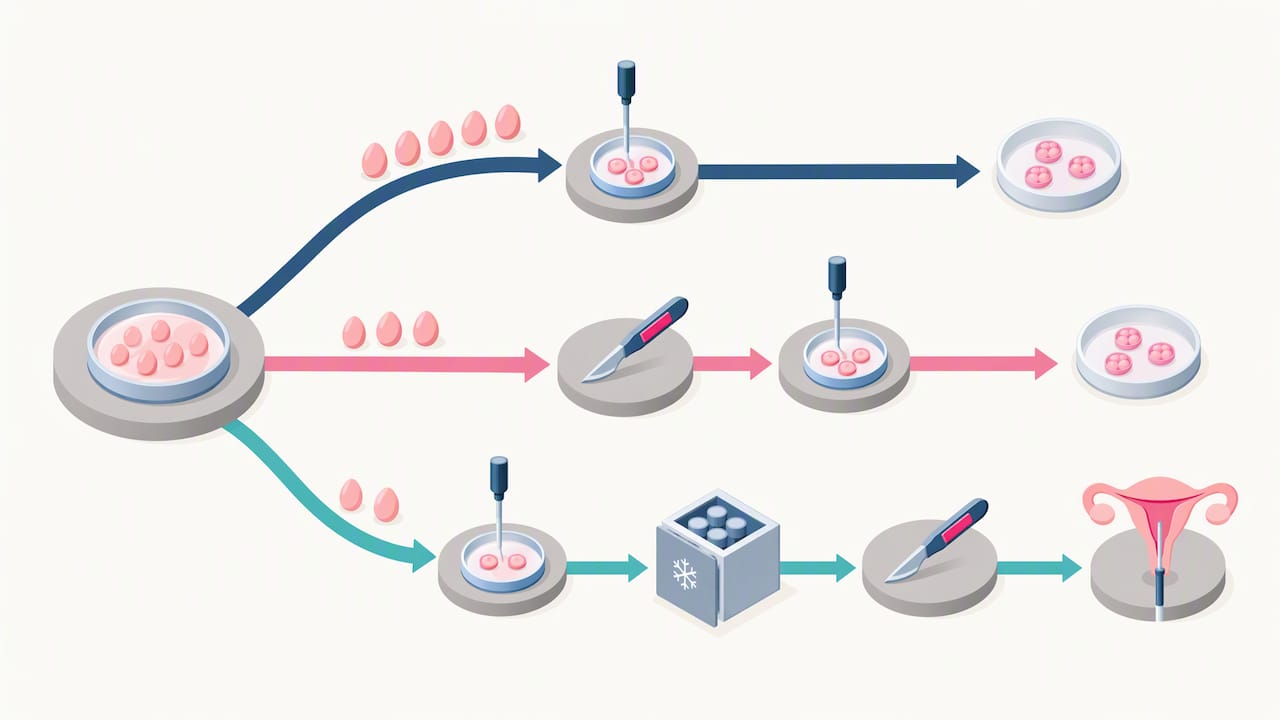
- Surgery first, then stimulation: the affected tube is treated before starting IVF medications, with either a fresh or frozen transfer to follow once healing is confirmed.
- Retrieval first, surgery after: eggs are retrieved and embryos frozen, then the tube is treated before a later frozen embryo transfer.
A 2026 analysis on timing of surgical treatment relative to IVF outcomes found broadly similar pregnancy and live birth rates between these two pathways, though time and cost differed and complication profiles varied by group. Optimal timing, and exactly how long to wait after surgery before transfer, remains an open question in the literature.
In practice, age and ovarian reserve often tip the decision. Patients with diminished reserve or advancing age may prioritize minimizing delay, sometimes choosing retrieval first to preserve time. Younger patients with more reserve, or those with complex adhesions needing careful surgical planning, may tolerate a surgery-first approach more comfortably.
Checklist: questions to bring to your fertility team
A focused conversation with your IVF team can clarify which path fits your anatomy and timeline.
- Ask which imaging confirmed the diagnosis (HSG, transvaginal ultrasound) and whether the hydrosalpinx communicates with the uterine cavity.
- Ask which surgical options, salpingectomy or tubal occlusion, are feasible given your anatomy, and how the surgeon plans to protect ovarian blood supply.
- Ask about expected recovery time and how that affects your IVF timeline.
- Ask whether the clinic recommends surgery before or after retrieval in your specific case, and why.
- Ask how your plan is individualized rather than templated, and how surgical care is coordinated with embryo transfer timing.
Life IVF Center’s approach to hydrosalpinx and IVF
Our approach to hydrosalpinx management considers each patient’s unique situation rather than applying a one-size-fits-all solution. Diagnostic imaging, ovarian reserve, and surgical history are reviewed before recommending appropriate treatment options such as salpingectomy, tubal occlusion, or less invasive alternatives. Surgical timing is coordinated with embryo transfer planning to align with individual anatomy and goals rather than following a fixed protocol.
— Ben
How Life IVF Center can help: consult, planning, and next steps
If you are weighing surgery against aspiration, or trying to figure out when treatment should happen relative to your IVF cycle, we can walk through the options with you directly. Our team reviews your imaging, prior history, and ovarian reserve to shape a plan under our Precision IVF® approach rather than applying a standard script.

- Pre-IVF testing, including the Infectious Disease (ID) Panel and related pre-IVF services, helps confirm readiness before any surgical step.
- Coordination between surgical planning and your treatment package options keeps your timeline organized instead of fragmented across separate providers.
- An initial consult is the place to bring your imaging and history so we can map out which pathway fits your case.
You can review our Precision IVF® approach or book a consultation to start that conversation.
This article is general information, not a substitute for advice from a qualified doctor. Consult a qualified healthcare professional about your own circumstances before acting on anything here.
FAQ
Does hydrosalpinx ever go away on its own?
Hydrosalpinx does not typically resolve without treatment, since the underlying tubal blockage causing the fluid buildup generally persists. Aspiration can drain fluid temporarily, but recurrence is common without surgical correction.
Is it possible to get pregnant if you have hydrosalpinx?
Pregnancy is possible with hydrosalpinx, but the condition is linked to lower implantation and clinical pregnancy rates in IVF, according to Cochrane’s review of surgical treatment before IVF. Treating or isolating the affected tube before embryo transfer is associated with improved pregnancy rates compared with leaving it untreated.
What is the success rate of IVF with blocked fallopian tubes?
Outcomes vary by whether the blockage causes hydrosalpinx and whether it is treated first. The Cochrane review found that, starting from an assumed clinical pregnancy rate without surgery, rates after salpingectomy ranged notably higher in the studies reviewed.
Can you get hydrosalpinx without a sexually transmitted infection?
Yes, hydrosalpinx can develop from causes other than sexually transmitted infections, including prior pelvic surgery, endometriosis, or non-sexually-transmitted pelvic infections. Any process that scars or blocks the fallopian tube can lead to fluid accumulation over time.
Sources
- Cochrane Review: Surgical treatment for tubal disease in women due to undergo IVF (CD002125)
- WHO guidance on management of tubal blockage and hydrosalpinx (NBK620431)
- ASRM committee opinion: Role of tubal surgery in the era of ART
This article is for general educational purposes only and is not a substitute for personalized medical advice, diagnosis, or treatment. Fertility care is highly individual; please consult a qualified healthcare professional about your specific circumstances.
