
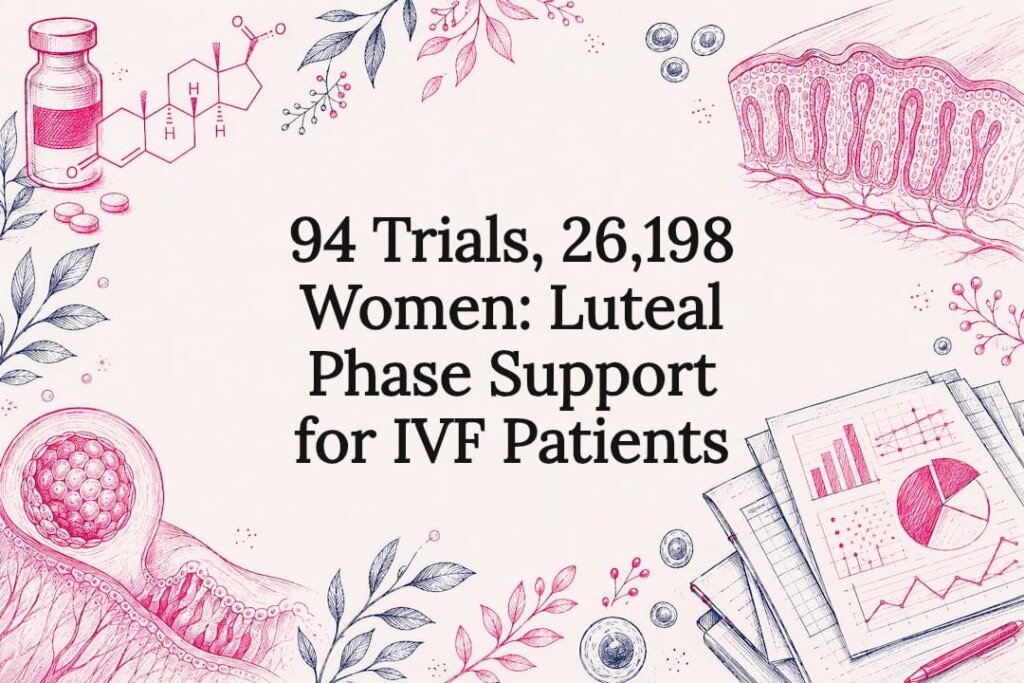
Luteal phase support is generally recommended for stimulated ART cycles, with progesterone as the primary foundational treatment. The main exception involves hCG-based regimens, which raise the risk of ovarian hyperstimulation syndrome and are generally avoided in higher-risk patients. Talk with your clinic about which protocol fits your stimulation history and trigger type.
TL;DR:
- Progesterone remains the cornerstone of luteal phase support in stimulated ART cycles, with hCG used only selectively due to its risk of ovarian hyperstimulation syndrome.
- In GnRH-agonist trigger cycles, supplemental support is often necessary because the corpus luteum produces less progesterone than in hCG-triggered cycles.
- Vaginal delivery of progesterone is most common but may cause local discomfort, while intramuscular injections provide more predictable hormone levels at the cost of injection-related pain.
- Starting progesterone support within three days after egg retrieval and continuing through the two-week wait, stopping if pregnancy fails, optimizes outcomes.
- Individualized protocols that consider trigger type, transfer method, and patient history outperform generic approaches, with no single route or dose being universally best.
Table of Contents
- What Is Luteal Phase Support and Why Does Stimulation Disrupt It?
- What Does the Evidence Actually Show?
- Vaginal, Intramuscular, Subcutaneous, or Oral: How Do the Routes Compare?
- When Should Luteal Phase Support Start, and When Can It Stop?
- How Do Clinics Personalize and Monitor Luteal Phase Support?
- What Are the Risks and Side Effects of Luteal Phase Support?
- How Can You Support Your Luteal Phase Day to Day?
- Why Individualized Luteal Phase Support Matters More Than the Protocol on Paper
- Ready to Discuss a Personalized Luteal Phase Plan?
- Sources
- FAQ
What Is Luteal Phase Support and Why Does Stimulation Disrupt It?
In a natural cycle, the corpus luteum, a temporary hormone-producing structure that forms after ovulation, produces progesterone to thicken and stabilize the uterine lining so an embryo can implant. That progesterone supply typically holds steady until the placenta takes over hormone production around eight to ten weeks of pregnancy.
Ovarian stimulation for IVF throws that system off balance. Retrieving multiple eggs requires high doses of gonadotropins, which suppress the pituitary hormone (LH) that normally sustains the corpus luteum after ovulation. The result is a shorter-lived, less productive corpus luteum than in an unstimulated cycle, and often a luteal phase that simply cannot generate enough progesterone on its own.
The trigger shot used to mature eggs before retrieval matters too. An hCG trigger initially oversupports the corpus luteum, but the surgical removal of granulosa cells during egg retrieval still leaves a shortfall later in the cycle. A GnRH-agonist trigger, often chosen specifically to reduce OHSS risk, produces an even shorter LH surge and a corpus luteum that underperforms compared to hCG-triggered cycles. Clinics frequently modify luteal phase protocols specifically because GnRH-agonist triggers yield less functional corpus luteum activity than hCG triggers, often adding supplemental luteotropic support to compensate.
This is why luteal phase support has become standard practice, not an optional add-on, in stimulated IVF and ICSI cycles. Without it, the endometrium may not receive adequate progesterone at the exact window an embryo needs it, and implantation rates suffer.
A few mechanisms explain why this gap appears so consistently:
- High-dose gonadotropin stimulation suppresses natural LH production for days to weeks after retrieval.
- Follicle aspiration during egg retrieval physically removes granulosa cells that would otherwise become part of the corpus luteum.
- Supraphysiologic estradiol levels from stimulation can directly impair luteal function.
- GnRH-agonist triggers shorten the LH surge duration compared to a natural or hCG-triggered cycle.
Frozen embryo transfer (FET) cycles complicate the picture further. In a natural or modified-natural FET, the patient’s own corpus luteum may still be present and functioning, reducing the need for aggressive support. In a programmed (hormone-replacement) FET, there is no corpus luteum at all, since ovulation never occurs, so luteal phase support becomes the entire source of progesterone rather than a supplement to it.
What Does the Evidence Actually Show?
The single most cited body of evidence on this topic comes from a Cochrane systematic review that pooled 94 randomized controlled trials covering 26,198 women. It found that both progesterone and hCG, when given during the luteal phase, were associated with higher live birth or ongoing pregnancy rates compared to placebo or no treatment at all. That sounds like a clean win for hormonal support, and broadly it is, but the review’s authors rated the certainty of most comparisons as low to very low, largely because trial designs varied enormously in dose, route, and timing. The review also flagged a specific harm: hCG-based luteal support increased the risk of ovarian hyperstimulation syndrome compared to progesterone alone.
That finding alone explains why hCG is used selectively rather than routinely for luteal support due to OHSS risk. Progesterone carries none of that OHSS signal, which is one reason it has become the default rather than an alternative among equals.
More recent evidence has tried to answer a narrower question: among the many ways to give progesterone, and among the various add-on drugs, which combinations perform best? A 2023 network meta-analysis pooling 76 trials and 26,536 participants found that some combined regimens including vaginal progesterone plus subcutaneous GnRH agonist may offer improved outcomes compared to vaginal progesterone alone in certain protocols. The catch is that these combinatorial regimens also showed variable trade-offs for OHSS and multiple pregnancy, meaning a modest efficacy gain can come bundled with added risk depending on the patient’s baseline profile.
Statistic Callout: Across the Cochrane review’s 94 trials, both progesterone and hCG outperformed placebo on live birth outcomes, but the evidence was graded low to very low certainty, and hCG specifically raised OHSS risk. That combination, modest benefit paired with real safety trade-offs, is why most clinics reserve hCG for selected cases rather than routine use.
A few other patterns show up consistently across the newer literature:
- Adding estrogen on top of progesterone has not shown a clear, consistent benefit in recent systematic reviews and meta-analyses, despite once being a common add-on.
- Intramuscular progesterone may hold a modest advantage in certain frozen embryo transfer scenarios, according to a Frontiers review, though the effect is not universal.
- GnRH-agonist addition can improve outcomes in some studies without a corresponding rise in OHSS, distinguishing it from hCG-based approaches.
- Fresh and frozen transfer cycles do not respond identically to the same protocol, which is part of why blanket recommendations struggle to hold up across settings.
A 2023 review in Nature Reviews Endocrinology went as far as describing luteal phase support as still partly a “black box,” with genuine uncertainty about the optimal route, dose, and duration for any individual patient. That review also underscored a point that shapes everything downstream: whether a corpus luteum is present at all meaningfully changes both LPS requirements and pregnancy complication risk, which is exactly why fresh cycles, natural FET, and programmed FET each call for different thinking.
Put together, the evidence supports a fairly clear clinical hierarchy: progesterone is the foundation of luteal phase support across virtually every protocol, hCG is used selectively because of its OHSS signal, and adjuncts like GnRH agonist or estrogen are added case by case rather than routinely. The heterogeneity across trials means no single “best” protocol has been proven superior for every patient, which is precisely the gap that individualized planning tries to close.
Vaginal, Intramuscular, Subcutaneous, or Oral: How Do the Routes Compare?
Every route of progesterone delivery gets the hormone into your system, but they differ meaningfully in how they feel day to day, how consistently they raise blood levels, and how much they interfere with normal life during a two-week wait that already feels long enough.
Vaginal progesterone is the most widely used route in stimulated IVF cycles, typically as a gel, suppository, or insert. It delivers progesterone directly to the uterus through what researchers call a “first uterine pass effect,” achieving high local endometrial concentrations even though blood serum levels can look unexpectedly low on a lab report. The tradeoff is a daily nuisance factor: vaginal discharge, a sensation of leakage, and for some patients, local irritation. None of that reflects a lack of efficacy, since the endometrial tissue is getting exposed to progesterone even when serum numbers look modest.
Intramuscular progesterone, given as a daily injection typically into the hip or buttock, produces more predictable and generally higher serum progesterone levels than vaginal routes. Some evidence, including a Frontiers review of frozen embryo transfer protocols, suggests IM progesterone may carry a modest advantage in certain FET scenarios specifically. The cost is administration burden: the injections use a thick oil-based solution, often require a partner or another person to administer them, and can cause soreness, swelling, or hardened tissue at the injection site over a multi-week course.
Subcutaneous progesterone is a newer formulation designed to close the gap between the two older options. Given as a smaller injection just under the skin rather than deep into muscle, it is easier to self-administer and generally causes less pain than intramuscular shots, while still producing systemic absorption more consistent than vaginal delivery alone.
Oral progesterone exists but is used far less often as a stand-alone luteal support method in ART, largely because oral progesterone has lower bioavailability due to first-pass metabolism and is less commonly used alone for luteal support, making it a less reliable primary agent compared to vaginal or injectable routes.
A quick side-by-side of what patients actually experience:
- Vaginal: convenient self-administration, no needles, but daily discharge and variable serum readings.
- Intramuscular: strong, predictable serum levels, but needle anxiety, injection site pain, and dependence on another person to inject.
- Subcutaneous: easier self-injection than IM, less pain, growing use in combinatorial protocols.
- Oral: simplest to take, but generally not relied upon alone due to lower bioavailability.
Pro Tip: If injection-site soreness becomes a problem with intramuscular progesterone, rotating sides daily, warming the vial slightly before injecting, and applying a warm compress afterward can meaningfully reduce discomfort without changing the dose your clinic prescribed.
Route selection is rarely arbitrary. Clinics weigh whether you’re in a fresh or frozen cycle, whether you have a history of vaginal irritation or needle aversion, whether you have support at home for daily injections, and whether your case falls into a category (like certain FET protocols) where the evidence tilts toward one route over another. None of the major reviews crown one route as universally superior, which is exactly why this remains a conversation rather than a fixed rule.
When Should Luteal Phase Support Start, and When Can It Stop?
Timing matters almost as much as the choice of drug itself, and the research points to a fairly narrow initiation window rather than a wide range of acceptable start dates.
-
Starting after egg retrieval (fresh cycles): Multiple trials and pooled analyses support beginning progesterone somewhere between the evening of oocyte retrieval and up to three days afterward, with some randomized trials favoring earlier initiation within that window rather than delaying. Starting meaningfully later than that window has not shown a consistent advantage and may leave the endometrium under-supported at a critical moment.
-
Starting for natural-cycle FET: When a patient still ovulates on their own and the transfer is timed around the LH surge, luteal support often begins a set number of days after that surge is detected, since the patient’s own corpus luteum is already contributing progesterone.
-
Starting for programmed (hormone-replacement) FET: Because ovulation never occurs in a programmed cycle, progesterone start dates are calculated backward from the planned transfer day, timed precisely to mimic the interval an embryo would naturally experience before implantation.
-
Continuing through the two-week wait and beyond a positive test: If the pregnancy test is negative, support is stopped. If it is positive, most protocols continue progesterone through roughly seven to twelve weeks of pregnancy, the window during which the placenta gradually takes over hormone production, though exact stopping points vary by clinic and by how the pregnancy is progressing on ultrasound and bloodwork.
-
Handling a missed dose: A single missed vaginal dose or a delayed injection by a few hours is unlikely to be catastrophic given how these formulations are designed to maintain tissue levels, but any missed or significantly delayed dose should be reported to your clinic the same day rather than adjusted on your own.
The rationale behind these windows isn’t arbitrary convention. It reflects the biological timeline of when an embryo is expected to reach the endometrium and attempt implantation, and the goal is to have adequate progesterone support in place slightly before that window opens rather than scrambling to catch up afterward.
How Do Clinics Personalize and Monitor Luteal Phase Support?
Serum progesterone testing during the luteal phase is common, but it comes with a caveat many patients aren’t told upfront: there is no single universal cutoff number that predicts success or failure, and a higher reading does not automatically mean a better outcome. Endometrial receptivity, the uterine lining’s actual readiness to accept an embryo at the molecular level, and precise timing often matter more than an absolute serum number on a lab report. That’s a meaningful nuance, since higher serum progesterone does not reliably translate into better outcomes once a minimum adequate threshold has been met.
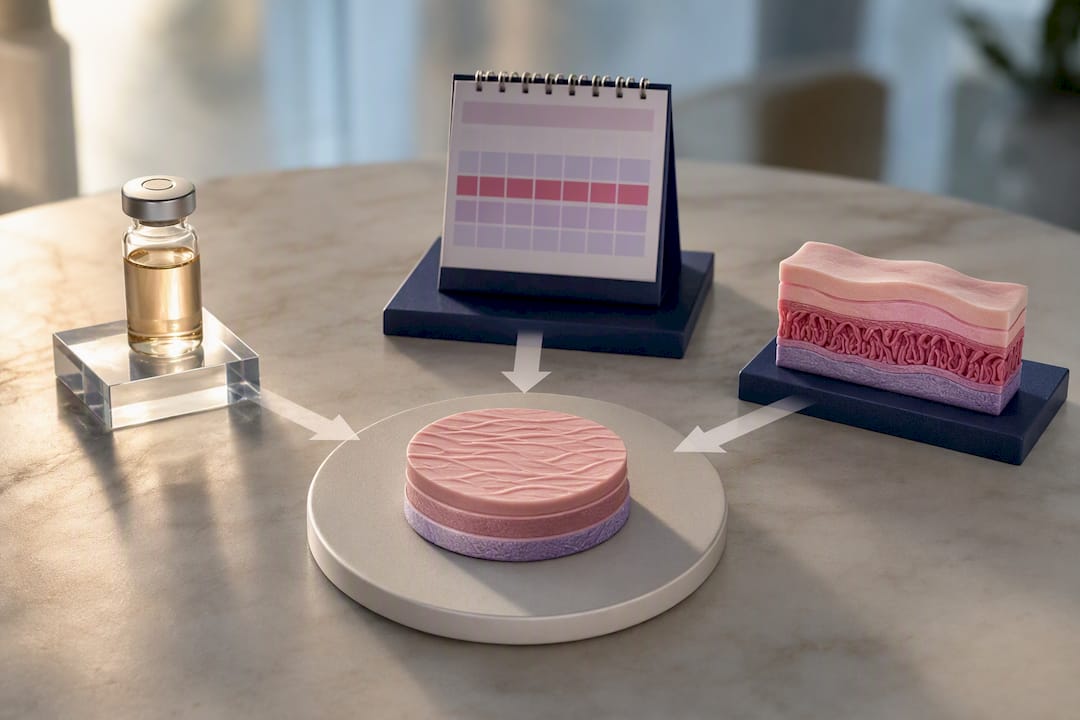
That doesn’t make monitoring pointless. It means testing is used to catch clear deficiencies and guide adjustments rather than to chase an arbitrary target number.
Clinics typically consider changing course in a handful of scenarios:
- A serum progesterone level that comes back unexpectedly low despite consistent use of the prescribed dose.
- A history of recurrent implantation failure (RIF), which sometimes prompts consideration of an added agent like GnRH agonist.
- A patient at elevated OHSS risk, where hCG-based support would be avoided even if it were otherwise being considered.
- A known allergic reaction or severe local intolerance to one formulation, prompting a switch in route rather than drug class.
- Body mass index and absorption considerations that may influence whether vaginal, intramuscular, or subcutaneous delivery is likely to achieve adequate levels.
Trigger type factors into this decision-making too. Patients who received a GnRH-agonist trigger, often chosen precisely to reduce OHSS risk in high responders, frequently need a different luteal support strategy than those triggered with hCG, since their corpus luteum function is inherently weaker from the start.
This is the logic behind Life IVF Center’s Precision IVF® approach: rather than assigning every patient the same default progesterone route and dose, the model accounts for a patient’s stimulation response, trigger type, prior cycle history, and individual risk factors before finalizing a luteal support plan. The aim, consistent with what a Frontiers review of luteal phase protocols describes as a shift away from one-size-fits-all dosing, is to match the support strategy to the biology in front of the clinician rather than a fixed protocol applied to everyone equally.
What Are the Risks and Side Effects of Luteal Phase Support?
The clearest safety signal in the research concerns hCG. Because hCG-based luteal support is associated with increased risk of ovarian hyperstimulation syndrome (OHSS) in the Cochrane review’s pooled trials, most clinics now reserve it for select cases and lean on progesterone as the default, safer foundation.
Statistic Callout: OHSS is the single most consequential risk difference between luteal support agents, not a side effect that appears equally across all options. Progesterone-based regimens do not carry that same signal.
Side effects still vary by route even among progesterone options:
- Vaginal progesterone commonly causes discharge, a sensation of leakage, and occasional local irritation or itching.
- Intramuscular progesterone can cause injection-site pain, redness, swelling, or firm tissue nodules with repeated daily use.
- Subcutaneous progesterone tends to cause milder injection-site reactions than IM but still requires daily needle use.
- Oral progesterone can cause drowsiness or dizziness related to its metabolites, part of why it’s rarely used alone.
Administration burden deserves honest mention here too. Daily injections, whether IM or subcutaneous, often require a partner, family member, or visiting nurse for comfortable administration, and that logistical load is a real factor in patient experience even when a protocol is clinically effective.
Contact your clinic promptly, rather than waiting for a scheduled check-in, if you experience severe abdominal pain, rapid weight gain over one to two days, persistent vomiting, or shortness of breath. Those can signal OHSS or another complication that needs same-day evaluation.
How Can You Support Your Luteal Phase Day to Day?
Adherence and comfort matter just as much as the prescription itself, since a perfect protocol only works if it’s actually followed consistently for the full duration your clinic recommends.
-
Store medications correctly and set a fixed daily time. Many progesterone formulations need refrigeration or protection from heat and light; check your specific product’s instructions and take your dose at roughly the same time each day to keep tissue levels steady.
-
Minimize discomfort with small technique adjustments. For vaginal progesterone, lying down for a few minutes after insertion can reduce leakage. For injections, rotating sites and warming the vial slightly beforehand tends to ease discomfort.
-
Support your body with steady nutrition, not a fix-all diet. Blood-sugar-stabilizing meals with protein, fiber, and complex carbohydrates, along with consistent hydration, can ease some of the fatigue and mood swings common during the luteal phase. Nutrition strategies that emphasize complex carbohydrates, fiber, and healthy fats are worth discussing with your care team as supportive measures, particularly if you’re also managing a condition like PCOS.
-
Keep exercise moderate. Gentle movement like walking supports circulation and mood without adding physical strain during a sensitive window.
-
Prepare a short list of questions for your clinic, including: What route and dose am I on, and why this one for my case? When exactly should I start, and when will we know whether to stop or continue? What symptoms should prompt an urgent call rather than waiting?
Pro Tip: Keep a simple daily log of dose times and any side effects on your phone. It sounds unnecessary until a nurse asks exactly when your last dose was, and “sometime this morning” isn’t a useful answer during a time-sensitive decision.
One myth worth retiring directly: no diet, supplement, or lifestyle change substitutes for hormonal luteal support in ART. Nutrition can meaningfully support well-being during this phase, easing energy dips and appetite changes, but it does not replace the progesterone your endometrium needs to sustain implantation.
Why Individualized Luteal Phase Support Matters More Than the Protocol on Paper
The systematic reviews are honest about their own limits, and that honesty is exactly what should shape how patients think about their own plan. Low to very-low certainty evidence doesn’t mean progesterone doesn’t work. It means the trials behind that conclusion were too varied in dose, route, and timing to produce a single confident number for every patient. That’s a meaningfully different message than “we don’t know if this helps,” and it’s one that gets lost in oversimplified explanations.
What stands out most in the newer network meta-analyses isn’t a clear winner. It’s how much the “best” regimen shifts depending on trigger type, transfer type, and individual risk factors. A combinatorial regimen that improves outcomes in one population can carry an OHSS or multiple-pregnancy trade-off that makes it the wrong choice for someone else entirely. Treating luteal phase support as a single fixed protocol, rather than a decision tree with real branch points, is where a lot of well-meaning patient education oversimplifies the science.
The serum progesterone question deserves more attention than it usually gets, too. Patients are often handed a number without context, and a “low” reading can trigger unnecessary anxiety even when the endometrium is receiving adequate progesterone through local tissue delivery that a blood draw doesn’t fully capture. Understanding that a single serum value is a data point, not a verdict, changes how a patient should react to a lab result mid-cycle.
None of this argues against progesterone, hCG when appropriate, or adjuncts like GnRH agonist. It argues for treating the decision the way the evidence actually supports: as an individualized calculation built around a specific patient’s stimulation response, trigger, and history, not a default handed to everyone in the same waiting room.
— Ben
Ready to Discuss a Personalized Luteal Phase Plan?
If you’re preparing for a fresh or frozen embryo transfer and want a luteal phase support plan built around your own stimulation history rather than a generic default, a consultation at Life IVF Center is the direct next step. Bring your prior cycle records, your stimulation protocol and trigger type, and any documented reactions to progesterone formulations you’ve used before. That information lets the team evaluate your case through a Precision IVF® framework, weighing trigger type, transfer type, and personal risk factors before recommending a route, dose, and timeline.
During your consultation, ask directly about individualized luteal phase support options, including how your specific case might change the recommended route or duration compared to a standard protocol. You can book a consultation with Life IVF Center to start that evaluation and get a plan tailored to your transfer type and medical history.
This article is general information, not a substitute for advice from a qualified doctor. Consult a qualified healthcare professional about your own circumstances before acting on anything here.
Sources
- Cochrane Review: Luteal phase support for assisted reproduction cycles
- Luteal-phase support in assisted reproductive technology: An ongoing challenge (review)
- Luteal phase support in fresh and frozen embryo transfers (Frontiers)
FAQ
How Do I Support My Body During the Luteal Phase?
The most effective support is consistent use of the progesterone your clinic prescribes, taken at the same time daily, paired with steady nutrition and hydration to ease secondary symptoms like fatigue.
What Does Luteal Phase Support Mean?
It refers to hormonal medication, usually progesterone and occasionally hCG or GnRH agonist as an adjunct, given after ovulation or egg retrieval to help the uterine lining sustain a pregnancy until the placenta takes over hormone production.
What Should Be Avoided During the Luteal Phase?
Avoid skipping or adjusting prescribed doses without clinic guidance; supplements or diet changes should not replace hormonal luteal phase support, since nutrition can ease symptoms but cannot substitute for progesterone.
How Can I Fix My Luteal Phase?
A short or weak luteal phase in ART is addressed with prescribed progesterone support, not home remedies; a clinic may also adjust the route, dose, or add an agent like GnRH agonist based on your trigger type and cycle history, an approach Life IVF Center structures through its Precision IVF® framework.
This article is for general educational purposes only and is not a substitute for personalized medical advice, diagnosis, or treatment. Fertility care is highly individual; please consult a qualified healthcare professional about your specific circumstances.
